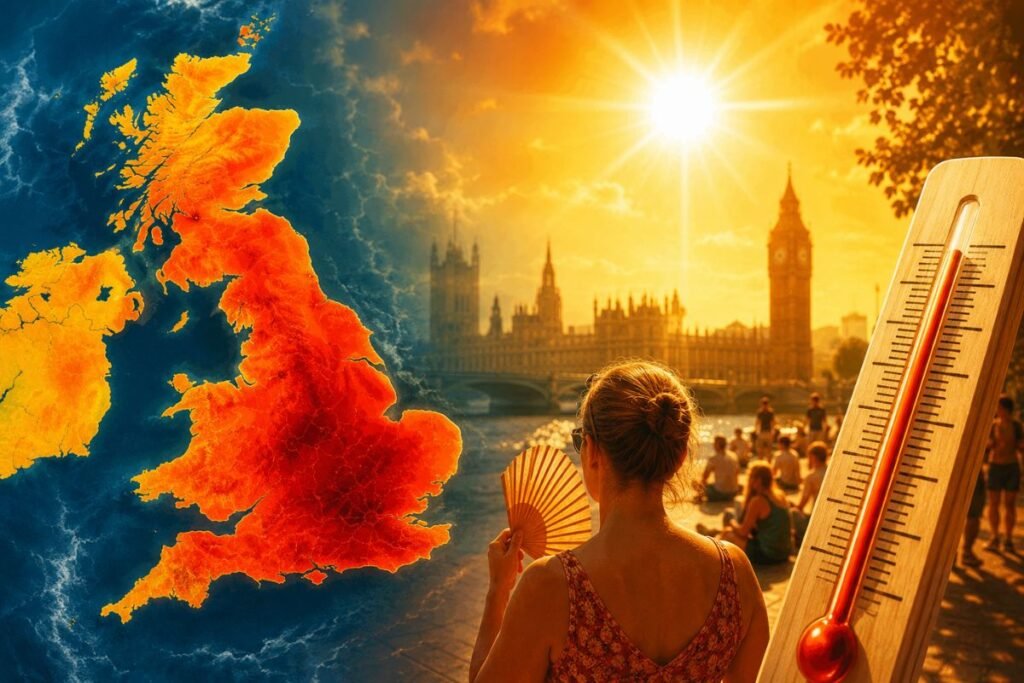
After a May that broke the all-time high record for temperature and left the Britons sweating and panicking about hosepipe bans, the Met Office has said that there is a high chance of a UK summer heatwave risk in 2026.
- The temperature was 35.1°C at Kew Gardens on the 25th of May.
- The Met Office says heatwaves are more common than ever.
- It could surpass the record of the summer of 1976.
- Parts of the South East already have a water shortage.
- There is some rainfall, but regional differences could be dramatic.
After last week’s extreme heat, it felt a bit strange to watch the rain hammer down on the first official day of meteorological summer. Classic Britain, really. But here’s the thing. That unsettled, cooler spell? It’s just a blip. The bigger picture, according to the Met Office’s freshly published three-month outlook, is that this summer has a well-above-average chance of turning seriously hot — possibly multiple times over. This isn’t the Met Office promising wall-to-wall sunshine from now until September. It’s more like a nudge — a statistical lean towards heat rather than a guarantee. But given what May just did to us, it feels like a nudge worth taking seriously.
May Was Absolutely Wild — And the Records Prove It
According to Sky News, on 25 May, Kew Gardens in south-west London clocked 35.1°C — breaking a UK May temperature record that had stood since 1944. The UK also recorded its warmest May night ever. Amber and yellow heat health alerts were issued for the first time in 2026. Thames Water reported an extra one billion litres of water used over the bank holiday weekend alone compared to the same period last year. Around 18,000 homes in the South East experienced supply disruptions because demand went too high.
What Does the Rest of Summer Actually Look Like?
Daytime temperatures will be as much as 15°C to 20°C lower than last week’s peak. Based on the Metro reports, there’ll be showers, longer spells of rain, a risk of hail and thunder, and the potential for localised flash flooding if any storms get particularly nasty. Further into June, the wet stuff should gradually retreat to the north-west, with high pressure starting to take over from the middle of the month. From around mid-June, things look drier and considerably warmer — with temperatures expected to climb well above average.
The Heatwave Warning Everyone’s Talking About
The three-month outlook, released by the Met Office on 1 June, is clear in its direction: hot conditions are more likely than usual for the UK this summer. Given global warming and El Niño, the natural climate pattern pushes temperatures higher across large parts of the world. Hotter summers are now, extraordinarily, twice as likely as they were in the 1991–2020 period. The things we once considered rare, sweltering anomalies are quietly becoming the new normal. Summer 2025 holds the title of the hottest summer on record for mean temperature, while July 2022 produced the highest ever single-day maximum — 40.3°C at Coningsby in Lincolnshire. Forty degrees.
In Lincolnshire. Are We Heading for a 1976 Repeat? (It’s the Summer’s 50th Anniversary, after all.) This summer also marks half a century since the legendary, notorious, oft-discussed summer of 1976 — still the benchmark most British people reach for when they’re trying to describe truly exceptional heat. It still holds the record for the highest average summer maximum temperature. Think about that — fifty years on, and that summer’s average peak still hasn’t been beaten.
The Bit Nobody Wants to Think About: Water
Even before summer has properly got going, water supply is already becoming a concern in parts of England. Spring 2026 was exceptionally dry in some areas — counties including Essex, Suffolk, Cambridgeshire, and Dorset received as little as a quarter of their usual rainfall. A quarter. River levels in parts of England are already falling to what hydrologists are calling “notably” or “exceptionally low” levels. If further heatwaves develop this summer — and the forecasts suggest they might — similar strain on water infrastructure looks increasingly likely. Restrictions could well return if dry conditions persist across the South and East.
What the Met Office’s Forecast Can (and Can’t) Tell You
The Secret London report on these forecasts puts it well: seasonal outlooks are “designed to guide planning across sectors such as healthcare, energy, and water management” rather than serve as day-by-day predictions. They reflect broad trends, not specific weather on a specific Tuesday. The Met Office itself is admirably honest about this. Even in a season where certain conditions are more likely, the UK can still experience a mix of weather types.
A hot summer can still have cooler or unsettled spells. A generally wet season can still include dry and sunny periods. Some parts of the country can experience very different conditions from others. What it does tell us — reliably, increasingly, uncomfortably — is the direction of travel. Hotter summers are coming more often. The question for 2026 isn’t really whether it’ll be warmer than average. The question is just how warm and for how long. Pack the suncream. Keep an eye on the hosepipe rules. And maybe don’t put the paddling pool away just yet.
Sources and References:
- Sky News – Kew Gardens in south-west London has broken the 82-year record.
- Met Office – Released a three-month outlook on the weather.
- Metro – There’ll be showers, longer spells of rain, a risk of hail and thunder.
- Secret London – The seasonal outlooks do not show day-by-day predictions.




Leave a Reply