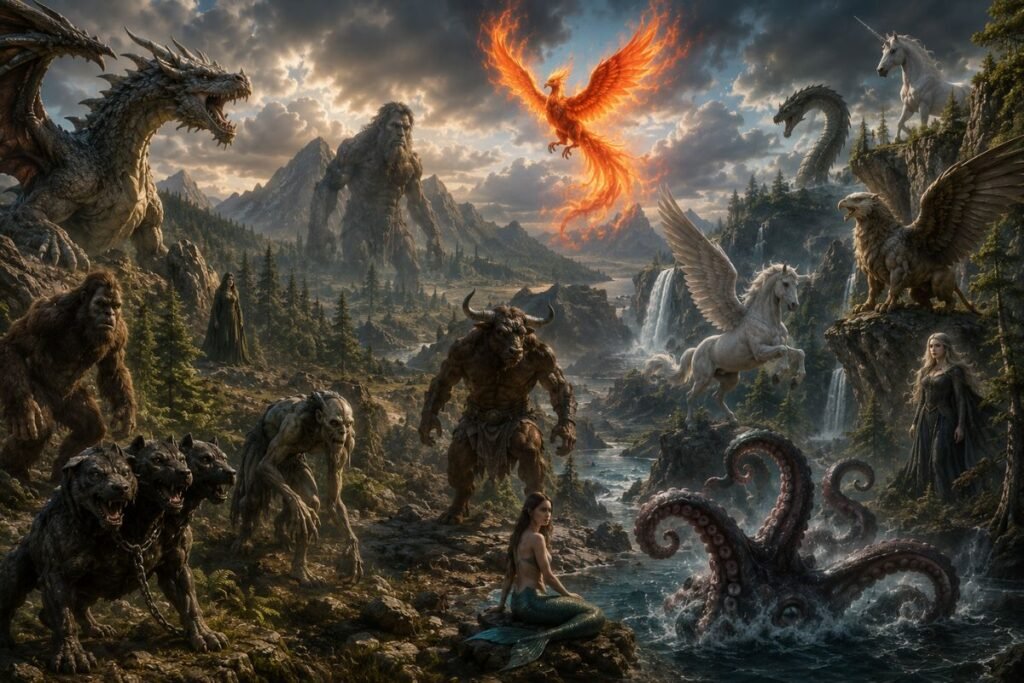
So you’ve got these 25 most famous mythical creatures, right? They’re everywhere- ancient Greek dragons, Norse giants, Celtic spirits. All over the place, different cultures, same kind of story. Folklore, books, films, you name it. The point is, they’ve always been about what we’re afraid of, what we want, what our minds can dream up.
- Show up everywhere. Explain the forces people couldn’t control back then.
- Got warnings in them. Don’t be arrogant, don’t get greedy.
- Help us deal with fear, death, and power. Way to process scary stuff.
- These 25 most famous mythical creatures last because they’re human underneath. Real emotions.
- Everywhere- ancient carvings, books, films, games. Meaning stays the same.
What Are Mythical Creatures?
The 25 most famous mythical creatures aren’t real. Never were. But people told these stories forever- half-human, totally wild, doesn’t matter. The point is, they dug into our brains. Changed how we see good, evil, and everything we don’t understand. Walk into a museum, flip through a book, watch a film, chat with someone at a pub. Chances are that mythical creatures come up. Ancient texts, modern stories, everyday chat. They connect our normal world to something we can’t quite touch or explain. That’s their power, honestly.
Greek and Roman Mythical Creatures
Dragons
You find dragons in basically every culture. But I’m talking about the Greek dragon specifically- Ladon. This thing guarded golden apples in a place called the Garden of the Hesperides. Not the standard fire-breathing dragon you see in films. Ladon was different. Multiple heads, never slept. Like, genuinely impossible to fight. Greeks saw dragons as representing greed, power, and the ultimate test. Something you couldn’t beat.
Minotaur
Think about this for a second. Half-bull, half-man, stuck in this maze that goes on forever. That’s what the Minotaur was. It represented something inside people that’s wild, savage, uncontrollable. Ancient Greeks were genuinely scared of it. They didn’t just tell stories- they sent actual people as tributes to get killed by it. Theseus came along and killed it, becoming a hero for doing so. Classic story.
Phoenix
The phoenix dies. Literally burns up. Then gets reborn from the ashes. Romans were obsessed with this. They loved what it represented- coming back stronger, renewal, living forever. See a phoenix in old Roman art? That meant hope, resurrection, you’re coming through this.
Medusa
One glance at Medusa’s face and you turned to stone. Permanent. Her head with snakes for hair became absolutely iconic. You see it everywhere now- shields, logos, tattoos. But here’s what people forget: she wasn’t always a monster. She got cursed. That makes her story tragic, honestly.
Pegasus
Pegasus was born from Medusa’s blood, which is metal. A winged horse. Symbol of freedom, divine power, all that. Every person who has ever dreamed of flying has probably thought about Pegasus at some point.
Also Read:
Norse Mythical Creatures
Fenrir
This is a giant wolf. According to Norse myth, when Ragnarok comes, it’s gonna eat Odin. Seriously. The Norse warriors didn’t treat this like fantasy- they believed it. Fenrir was pure destruction. The end of everything. Not metaphorical, actual.
Jormungandr
Fenrir’s sibling. The Midgard Serpent. Wrapped around the world. So massive that when it moved, it created tsunamis. You can’t really capture how huge Norse mythology thought this thing was. Nothing explains the scale as Jörmungandr does.
Valkyries
These weren’t just regular warriors. They picked who lived and who died in battle. Then they carried the dead off to Valhalla. They’re fierce, intelligent, and honestly, some of the most respected female figures in mythology. Not sideline characters.
Celtic and European Creatures
Banshee
That wailing, screaming sound? In Irish folklore, that means death is coming. For real. The banshee showed up to warn specific families. Not a fun experience. Hearing one was bad news, genuinely bad. Celtic culture took this seriously.
Werewolf
A werewolf is a creature that can shape-shift from human to wolf and back, often triggered by the full moon – a transformation believed in many accounts to happen either intentionally or unwillingly.
Selkies
Seal-people. Could take off their seal skin and walk around as humans. Scottish and Irish stories talked about them like they were real- mysterious, sometimes sad. Stuck between two worlds. Modern fantasy borrows from selkies all the time because the idea just works.
Griffins
Half-eagle, half-lion. They guarded treasure and represented strength and nobility. Medieval Europe loved griffins as symbols of protection and power.
Asian Mythical Creatures
Dragons (Asian)
Completely different from Western dragons. Asian dragons brought good luck, controlled water, and represented imperial power. China saw them as divine, not monsters. That’s a major difference in how cultures think about the same creature.
Kitsune
Japanese foxes that could shapeshift into humans. Clever, mischievous, sometimes genuinely malicious. Japanese folklore warns you- you never really know if the person you’re talking to is human or wearing a fox disguise. Paranoid but clever concept.
Djinn
The Djinn (also spelt Jinn) is a spirit entity mentioned throughout Islamic texts and Arab folklore, believed to be made of smokeless fire, capable of taking human or animal form, and possessing free will to be either good or evil.
Naga
Hindu mythology gave us these serpent beings. Half-human, half-snake. They protected treasures, sometimes helped, sometimes destroyed. They showed the duality of nature itself- good and evil mixed together.
Also Read: 125 Hilarious Golf Jokes That Are Tee-rific To Share
Other Famous Creatures
Bigfoot
Part legend, part cryptid. It exists in this weird space between folklore and something people claim is actually real. Whether it’s real or not, Bigfoot taps into something- our need to believe something wild is still out there. That’s powerful.
Kraken
This octopus-like monster supposedly pulled ships down into the ocean. Sailors were more scared of it than actual storms. Modern science suggests giant squid inspired these stories, which makes sense. But the fear was real.
Cerberus
Three-headed dog guarding the gates of the Underworld. Didn’t let souls out. Ever. Hercules had to fight it as his twelfth labour. One of the most genuinely formidable creatures in Greek mythology.
Chimera
Fire-breathing, weird mix: lion’s head, goat’s body, serpent’s tail. It represented impossible combinations. Nature is broken. Greek heroes killed it but not without struggle.
Hydra
Kill one head and two grow back. The Lernaean Hydra drove Hercules absolutely mad, trying to figure out how to beat it. It stood for unsolvable problems. Every time you think you’ve won, it gets worse.
Mermaid
A mermaid is a legendary aquatic creature with the upper body of a human female and the tail of a fish, appearing across many cultures and often symbolising temptation and the mystery of the sea.
Sphinx
Riddle asker. Guardian. The Egyptian sphinx kept secrets. The Greek sphinx killed people who couldn’t answer her riddles. Oedipus solved it and became king. Pretty high stakes.
Siren
Not the fish-tailed thing Disney made. Ancient sirens lured sailors to their deaths with irresistible music. They embodied temptation and wanting things that kill you.
Unicorn
A horse-like creature with a single, spiralling horn on its forehead, the unicorn is a symbol of purity, grace, and innocence and is a recurring motif in European folklore.
Comparison Table: Famous Mythical Creatures
| Creature | Origin | Type | Key Trait |
|---|---|---|---|
| Dragon (Greek) | Greek | Reptile | Power, greed, ultimate challenge |
| Minotaur | Greek | Hybrid (bull/human) | Imprisonment, savagery |
| Phoenix | Roman | Bird | Resurrection, immortality |
| Medusa | Greek | Monster | Petrification, tragedy |
| Pegasus | Greek | Winged Horse | Freedom, divine power |
| Fenrir | Norse | Wolf | Destruction, end of gods |
| Jormungandr | Norse | Serpent | World-scale chaos, tsunamis |
| Valkyries | Norse | Spirit/Warrior | Death choosers, Valhalla |
| Banshee | Celtic | Spirit | Death warning, wailing |
| Selkies | Scottish/Irish | Seal-human | Duality, mystery |
| Griffin | Medieval European | Hybrid (eagle/lion) | Nobility, treasure guardian |
| Werewolf | European | Shapeshifter | Duality, primal instinct |
| Dragon (Asian) | Chinese | Reptile | Good luck, imperial power |
| Kitsune | Japanese | Fox | Trickery, shapeshifting |
| Naga | Hindu | Serpent/Human | Duality, protection |
| Djinn | Islamic/Arab | Spirit | Free will, smokeless fire |
| Bigfoot | North American | Cryptid | Wild unknown, primal fear |
| Kraken | Scandinavian | Cephalopod | Ocean terror, ship destroyer |
| Cerberus | Greek | Three-headed Dog | Underworld guardian |
| Chimera | Greek | Hybrid (lion/goat/serpent) | Impossible combinations |
| Hydra | Greek | Multi-headed Serpent | Unsolvable problems |
| Sphinx | Egyptian/Greek | Hybrid (lion/human) | Riddles, mystery |
| Siren | Greek | Bird/Human | Temptation, death by music |
| Unicorn | European | Horned Horse | Purity, grace, innocence |
| Mermaid | Worldwide | Aquatic Human | Temptation, sea mystery |
Also Read: 21 Longest Words in English and Their Meanings Worth Knowing
FAQs
Are mythical creatures real?
Nope. They’re made up. Folklore, cultural storytelling, imagination. But- and this is interesting- some probably started from real animals or natural events that people didn’t fully understand. They saw something and turned it into a story.
Which mythical creature appears most across cultures?
Dragons, hands down. Nearly every civilisation independently came up with dragons. Tells you something about how human brains work, right? We all had that same need for the ultimate challenge.
Why do cultures create mythical creatures?
Because stuff was scary and unexplainable. How do you talk about danger, death, power, the unknown? Mythical creatures gave you a way. Processing tool for society.
Which creature killed the most people in mythology?
Fenrir and the Hydra both caused massive destruction. But Fenrir actually kills Odin during Ragnarok. That’s catastrophically powerful in Norse belief.
Are cryptids like Bigfoot mythical creatures?
Not quite. Cryptids are different- people actually claim to see them. Mythical creatures are understood as pure legend. There’s a difference between “people saw this” and “this is a story we tell.”
Sources and References
Greek & Roman
Norse




Leave a Reply