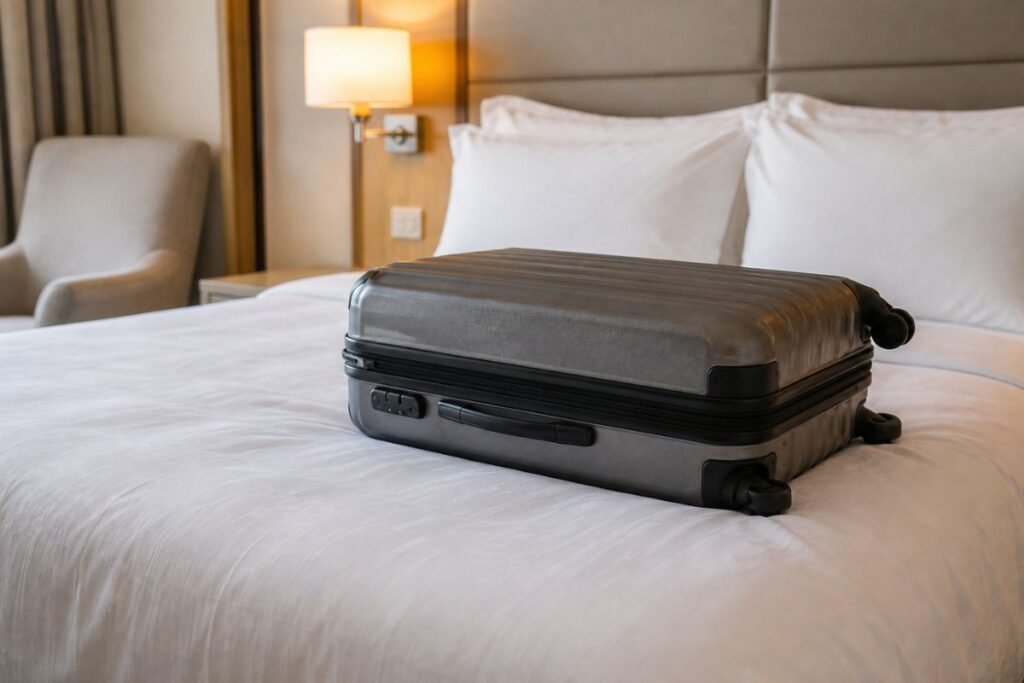
Never put your case on the hotel bed. Lab swabs found suitcase wheels carrying 58 times more bacteria than a public toilet seat. Bed bugs also favour soft bedding. Use the luggage rack, a hard desk, or the tiled bathroom floor instead. It sounds like a fussy rule. The lab results are not fussy, and they explain why travel experts advise against unpacking suitcases on hotel room beds. Your bag is dragged through terminals, taxis and wet pavements, then lands on the surface you sleep on.
- Suitcase wheels tested at about 400 CFU per 3 sq cm.
- Close to 58 times the bacteria on a public toilet seat.
- Bedbugs are the UK’s fourth most common pest problem.
- Warmer temperatures trigger a 67% surge in cases each year.
- 38% of travellers still unpack straight onto the bed.
- The safest spots are a luggage rack, a hard desk, or a tiled bathroom floor.
What Your Case Picks Up On The Way
Airport toilets, security belts, pavements, rideshares, and the aircraft hold: your case touches all of it. Travel insurer InsureandGo put numbers on that. In May and June 2025, microbiologist Amy-May Pointer swabbed ten cases at a busy airport train station in Greater London and incubated the samples for five days. The wheels came back dirtier, at around 400 CFU per 3 sq cm. The base followed at 350 and an airport trolley handle at 280, roughly 40 times a public toilet seat.
The plates grew Staphylococcus, Bacillus cereus, presumptive E. coli and mould. Travel Bulletin summed it up: treat your suitcase like a pair of street shoes. Timothy Southern, director of the Nevada State Public Health Laboratory, explained the mechanism to Travel + Leisure. “It is likely your luggage has been in some unsanitary locations,” he says. Luggage acts as a fomite: it carries contamination between surfaces. “Some bacteria and viruses can persist on the surface of a suitcase and then contaminate bedding,” he adds.
Why Travel Experts Advise Against Unpacking Suitcases On Hotel Room Beds
Germs are half the story. Bed bugs are the other half, and reporting by the Express showed how worried UK travellers have become. Bedbugs are ranked fourth among Britain’s most common pest problems, and warm weather drives that 67% annual rise. After last summer’s heatwave, UK searches for ‘how to check for bedbugs’ soared by over 4,750% in just 30 days. Sharon Robson of Mattress Online sets out the first move clearly. “When you first arrive at your accommodation, be sure to elevate your luggage above carpets and away from walls.
Avoid unpacking your suitcase on the bed before you’ve had a chance to inspect it for signs of bedbugs. Use metal luggage racks or place your case on a hard surface like a table or desk.”
The bed is not the only risk, just the worst place to open a bag. Rob Anderson, a University of Winnipeg associate professor who studies blood-feeding pests, adds a caution. “In theory, trying to keep a suitcase from touching walls and carpet and beds, etc., might reduce the likelihood of bedbugs ‘climbing aboard’ because the luggage has reduced points of contact, but bedbugs, as with most insects, can climb really well,” he says. He now packs his luggage inside a large bin bag, tightly closed.
Also Read: From Hear’Say To The Royal Palace: The Story Of Myleene Klass
Where To Put Your Case Instead
The luggage rack is not decoration, and it predates wheeled cases by decades. No rack? Julie Durso, a travel advisor with Scott Dunn, suggests any sturdy furniture: a desk, a dresser, or the bench at the foot of the bed. Southern Living names the bathroom as the safest spot. “Bedbugs like soft surfaces and look for places to hide. That means they could crawl across a carpet and into your luggage,” the team wrote, adding, “Assuming it’s covered in tile. If not, keep your suitcase in the bathtub. You can also store your suitcase on a shelf in the closet.”
The Two-Minute Room Check
Check the rack itself too; straps and joints can hide bugs. Then try Robson’s credit card trick, using a plastic card and your phone torch. Bed bugs hide in tight spaces: mattress seams, labels, tufts, piping and bedframe corners. Shine the torch, then run the card along each crease, checking for bugs and eggs. Three signs matter:
- A sweet, musty smell, pointing to a severe infestation.
- Black or rust-coloured stains on bedding and mattresses.
- Empty brown casings, or flat oval brown shapes.
Some hotels fit Spotta, a 24/7 bed bug detector, but never skip your check.
What To Do At Home
The Mirror sets out the routine, and Robson is specific. “Leave your luggage on a hard surface, like a bathroom or laundry room floor and unpack directly into the washing machine. Clean your clothes on a hot wash cycle and dry on high heat for 30-60 minutes to kill any live bugs or eggs.” Then clean the bag. Jonathan Gardiner, research and development manager at Lysol, recommends disinfecting wipes for handles and hard shells, and a fabric-safe spray for soft-sided cases. Lift loose grit with a vacuum first. Microbiologist Jason Tetro told HuffPost: “Luggage touches everything on the journey, so the best thing to do is keep the surface clean and safe.”
Also Read: Headphone Dodgers: What the Term Means and Why They Are Becoming a Public Transport Concern
Hard Shell or Soft-Sided?
Hard-shell cases are better. Soft-sided luggage offers countless hiding places, and bed bugs cling to rough, porous materials. Polycarbonate gives them little to grip.
Old Habits Die Hard
Data from Real Simple found that 38% of travellers unpack directly onto the bed. A poll of 240 readers run by Afar matched it: 57% pack on the floor, 30% use the bed, and only 11% reach for a rack. If you must use the bed, lay a clean towel down and keep the case shut until it is in place. Then wash the towel hot.
Robson’s wider warning: “Bedbugs thrive in areas where lots of people are coming and going; they also favour warm and humid conditions, which means there’s a higher chance of infestations across the summer holidays.” She adds, “From hotels, hostels, and holiday rentals to public transport, it’s crucial to know how to spot a potential infestation to prevent bringing any unwanted souvenirs back from your trip.”
FAQs
- Why shouldn’t you put your suitcase on a hotel bed? Ans: The wheels and base carry street-level bacteria onto the bedding. Beds also give these bugs an open route into your bag and clothes.
- Where is the safest place to put luggage in a hotel room? Ans: Use the luggage rack first. Failing that, pick a hard desk, dresser or bench, or the tiled bathroom floor or bath.
- Are suitcase wheels really dirtier than a toilet seat? Ans: Yes. Swab tests recorded about 400 CFU per 3 sq cm on wheels, close to 58 times the bacteria on a public toilet seat.
- How do I check a hotel room for bed bugs? Ans: Run a plastic card along mattress seams, piping and bedframe corners with your torch on. Look for bugs, eggs, rust stains and a sweet, musty smell.
- Should I leave my suitcase on the hotel floor instead? Ans: Not on carpet. Hotel carpets hold dust, dust mites and fungi, and bed bugs crawl across them into soft luggage. Tiled floors are safer.
- What should I do with my clothes when I get home? Ans: Unpack straight into the washing machine and run a hot wash. Tumble dry on high for 30 to 60 minutes to kill any bugs or eggs.
Sources & References
- Mirror – Leave your luggage on a hard surface, like a bathroom or laundry room floor and unpack directly into the washing machine.
- Travel and Leisure – It is likely your luggage has been in some unsanitary locations.
- Express – Bedbug is ranked fourth among Britain’s most common pest problems.
- Travel Bulletin – Treat your suitcase like a pair of street shoes.




Leave a Reply