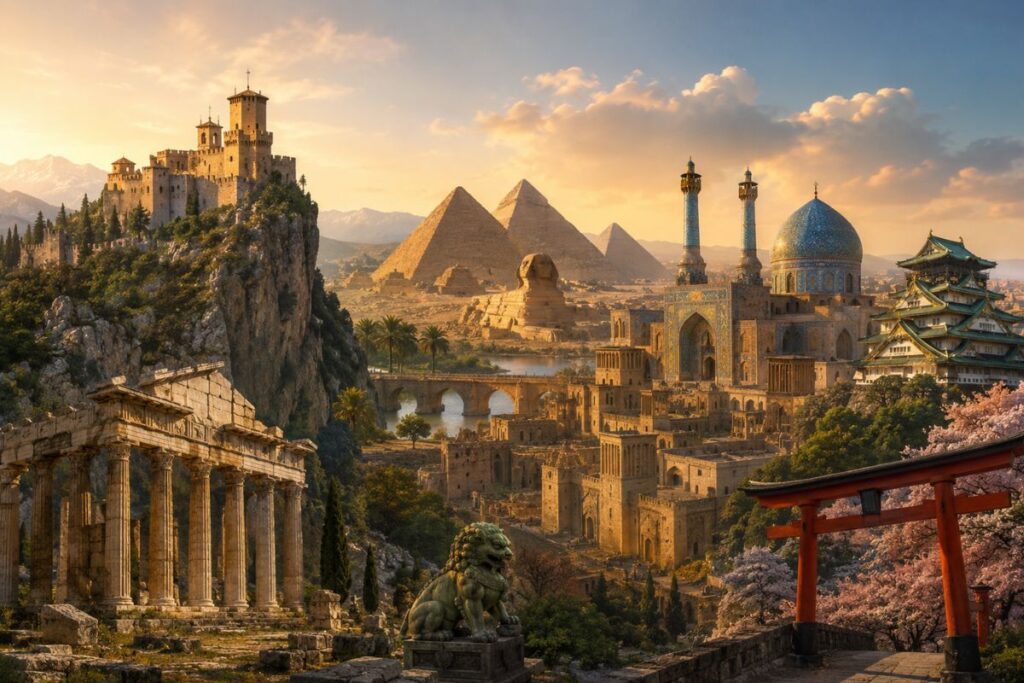
Here’s the real situation with finding the most ancient country in the world – nobody actually agrees on what makes a country “old.” San Marino’s been independent since 301 CE, which is nuts. Iran’s saying 3200 BCE. Egypt’s 3100 BCE. China’s throwing dates around, too. So what actually wins? The country that’s been running itself this whole time, or the one with the oldest people and culture? Historians literally argue about this. The most ancient country in the world depends on what you’re measuring, and everyone measures differently. It’s messy. You’ve got archaeology, history, culture, all competing. Nobody can agree.
- San Marino’s been running itself for 1,700+ years-never conquered, never absorbed
- Iran’s ancient Elamite government goes back to 3200 BCE, which is genuinely ancient
- Egypt’s First Dynasty kicked off around 3100 BCE under King Menes
- China’s dynasties rose and fell, but the system never actually broke-it just kept going
- Japan claims an imperial line stretching to 660 BCE, though early emperors are probably legendary
- The “oldest country” title changes depending on whether you count continuous independence, the oldest government, or cultural survival
What Does The Most Ancient Country In The World Actually Mean?
Figuring out the most ancient country in the world isn’t straightforward. The problem? “Oldest” means different things to different historians. A modern nation-state needs borders, a government, and a population. Ancient civilisations existed long before this concept existed. So you can’t simply crown one winner. Three approaches exist. First, uninterrupted modern sovereignty – does the country still exist as an independent state?
Second, the earliest organised government in a territory – when did formal rule begin? Third, cultural and civilisational continuity – did the people, language, and traditions survive? Each method produces different answers. That’s why the question of the most ancient country in the world sparks genuine scholarly disagreement.
San Marino: The Oldest Surviving Sovereign State In The World
San Marino wins on the independence front – no competition. Saint Marinus, a Dalmatian mason, set it up on September 3, 301 CE, to escape Roman persecution. He built a chapel on Monte Titano. That’s basically it. But somehow that tiny settlement just never fell. Wars, invasions, and empires collapsing around it – San Marino stayed put. Still independent. Still the same place 1,700 years later.
What makes San Marino remarkable is its incredible political resilience. While it has occasionally suffered brief foreign occupations – such as by Cesare Borgia in 1503 and briefly by military forces during World War II – it was never permanently absorbed into another nation. 1,700 years. That’s how long San Marino’s managed to stay independent. For a place that’s only 61 square kilometres surrounded by massive European empires constantly reshuffling boundaries, that’s genuinely impressive.
Neighbours got invaded, carved up, absorbed. San Marino kept its head down, played politics smart, and just refused to get swallowed up. The Republic also boasts the world’s oldest governing documents still in use: the Statutes of 1600. Written in Latin, this multi-book legal framework proves that the Sammarinese have governed themselves by documented legal principles, rather than luck, for centuries. If you measure the most ancient country in the world by continuous modern statehood, San Marino is the undisputed answer.
Iran: The Ancient Empire’s Claim To The Most Ancient Country In The World
Iran’s got a different angle. The Elamites started building organised cities around 3200 BCE-that’s 3,500 years before San Marino even existed. So yeah, Iran’s got a serious claim to be the most ancient country in the world. What actually matters, though, is that Iran didn’t just disappear. The original Elamite stuff merged with Indo-Iranian tribes, empires came and went, Islam showed up, dynasties collapsed, and revolutions happened.
Through all that chaos, something Iranian stayed. Farsi has been spoken for thousands of years. Persian poetry and philosophy never went away. That’s the real thing. But here’s the catch: Iran’s current borders and government? That’s from 1979. So if you’re counting modern statehood, Iran’s young. If you’re counting continuous civilisation and identity, Iran’s ancient as hell. This nuance matters. The most ancient country in the world depends entirely on whether you count modern political structures or the endurance of an ancient civilisation.
Egypt: The Most Ancient Country In The World With Pharaonic Roots
Egypt is almost as old as Iran. King Menes unified Upper and Lower Egypt around 3100 BCE, kicking off the First Dynasty. That’s one of humanity’s oldest documented kingdoms, no question. What’s wild about Egypt is that being Egyptian actually meant something through all the chaos. Greece ruled it. Rome conquered it. The Ottomans occupied it. Then Britain showed up. Everything changed constantly.
Yet somehow Egyptians stayed Egyptian. Language evolved but didn’t die. Traditions shifted but didn’t disappear. That’s not common. Modern Egypt became independent from Britain in 1922, though it didn’t officially become a republic until 1953. So, the current state? Young. The civilisation underneath? 5,000 years old. That’s why Egypt keeps showing up in the “oldest country” conversation – the cultural stuff runs that deep.
China: Unbroken Dynasty And The Most Ancient Country In The World
China presents an incredibly powerful case for civilisational longevity. Its recorded history materialises with the Shang Dynasty (c. 1600 BCE), which left behind extensive oracle bone writings. Before this, the Xia Dynasty (traditionally dated to c. 2070 BCE) served as the legendary foundation of Chinese statehood, though archaeologists still debate its exact historical boundaries. China’s got something going for it -cultural and bureaucratic continuity that’s genuinely hard to break. Sure, China fractured into warring kingdoms.
Got conquered by the Mongols, then the Manchus. Dynasties rose and fell constantly. But the script stayed. Confucianism came back. Chinese identity never actually died. It just kept resurfacing. Here’s what people get wrong, though: China didn’t have an unbroken government. The imperial system completely collapsed in 1912. That’s it. Millennia of dynasties just ended. Modern China is a different thing entirely.
Following decades of civil war and splintered warlord rule, the modern People’s Republic of China was established in 1949 under a completely different Communist framework. Therefore, while its political institutions are modern and revolutionary, China’s core civilisational identity remains one of the oldest and most thoroughly documented on Earth.
Japan: The Longest Continuous Monarchy
Japan’s got something different going on – the longest continuous monarchy in the world. They claim the imperial line goes back to Emperor Jimmu in 660 BCE. That’s over 2,600 years if you believe it. The thing is, historians know the early emperors are probably legendary. Can’t actually prove they existed. The first verifiable emperors show up around the 6th century CE. But the institution itself? Genuinely ancient.
Japan got hammered after World War II. Borders changed, government changed, and the emperor became more of a symbol than a ruler. But the imperial office never actually disappeared. It’s still there. That’s why Japan matters in the “oldest country” debate. The imperial system, Japanese identity, and Shinto traditions – they all stayed connected across centuries. When everything else shifts, that thread just keeps going.
Greece: Where Western Culture Began
Greece’s claim isn’t about politics – it’s about culture sticking around. Greek city-states popped up around 800 BCE. Democracy, philosophy, art, drama – all that Western civilisation stuff came from there. Earlier, the Mycenaeans had organised states around 1600 BCE. Modern Greece as a country? That’s from 1830, after they kicked out the Ottomans. But here’s the thing: being Greek actually meant something through all of it.
The Greek language is genuinely ancient, with 3,400 years of written records. Romans ruled, then Byzantines, then Ottomans. The language didn’t disappear. The identity didn’t disappear. Even democracy came back eventually. That’s the Greek angle on being one of the world’s most ancient countries. Not a continuous government. Just the fact that Greek stayed Greek.
Which Country Is The Most Ancient In The World? The Final Answer
The answer depends entirely on how you measure “oldest.” Here’s how different countries rank by different standards:
| Criteria | Winner | Timeline | Notes |
|---|---|---|---|
| Oldest Surviving Sovereign State | San Marino | 301 CE (1,725 years) | Continuously independent; suffered brief occupations but never permanently absorbed. |
| Earliest Documented Government | Iran | 3200 BCE | Traces of the Elamite civilisation, though the modern republic was established in 1979. |
| Earliest Organised Kingdom | Egypt | 3100 BCE | Traces to the unified First Dynasty, though the modern republic was established in 1953. |
| Oldest Continuous Dynastic System | China | 1600 BCE documented (possibly 2070 BCE) | Unbroken cultural, linguistic, and bureaucratic heritage, though the dynastic system ended in 1912. |
| Longest Continuous Monarchy | Japan | 660 BCE (legendary) | The imperial line remains active today, though early rulers are considered mythical. |
| Oldest Cultural Continuity | Greece, Egypt, Iran, China | Multiple timelines | Language, traditions, and distinct regional identities survived despite massive changes to borders and governments. |
Why Understanding The Most Ancient Country In The World Matters For Travellers
Understanding the world’s most ancient countries actually changes how you travel. Monuments stop being just tourist stuff. They become real connections to people and places across thousands of years. Egypt’s temples connect pharaohs to modern Cairo. Iran’s bazaars link medieval traders to what’s happening there right now. China’s temples connect ancient dynasties to today’s cities. When you walk through these places, you’re literally walking through history that never stopped.
FAQs
What’s the difference between a country and a civilisation?
A civilisation is a culture that lasts for centuries or millennia. A country is a modern political thing – borders, government, laws. You can have an ancient civilisation inside a young country.
Which is the most ancient country in the world if you count continuous sovereignty?
San Marino. It’s been independent since 301 CE and has never been conquered. That’s it.
Is the most ancient country in the world determined by civilisation age or modern government?
It depends on what you mean. Egypt and Iran? Ancient civilisations. San Marino? Oldest independent state. Different questions, different answers.
Can a country claim heritage if its modern government is young?
Yeah, absolutely. Egypt’s republic is from 1922, but Egyptian identity is 5,000 years old. That counts for something.
Which country has the oldest borders?
Most borders were drawn in the 1800s and 1900s. But Andorra’s border with Spain (1278) and Portugal’s mainland borders (1297) are genuinely old.
Is Japan really the most ancient country in the world by monarchy?
Japan claims an imperial line from 660 BCE. Early emperors are probably myth, but the monarchy itself is ancient. Oldest active one on Earth.
Sources & References
- World Population Review – Oldest Countries 2026
- Oldest.org – 10 Oldest Countries in the World
- Keghart – The Eleven Oldest Countries in the World
- Factually – Which Existing Country Today Is the Oldest
- TravelTriangle – Oldest Countries in the World
- History.com – Which Is the Oldest Country in the World?
- BBC News – San Marino Country Profile
- Encyclopaedia Britannica – History of San Marino
- Study.com – Unification of Egypt: Narmer & Menes
- Egypt Tours Portal – Narmer Palette & the Unification of Egypt
- Columbia University – Asia for Educators: Timeline of Chinese History
- Study.com – Chinese Dynasties Timeline
- Reddit – AskHistorians Discussion on the Oldest Countries/Civilisations




Leave a Reply