
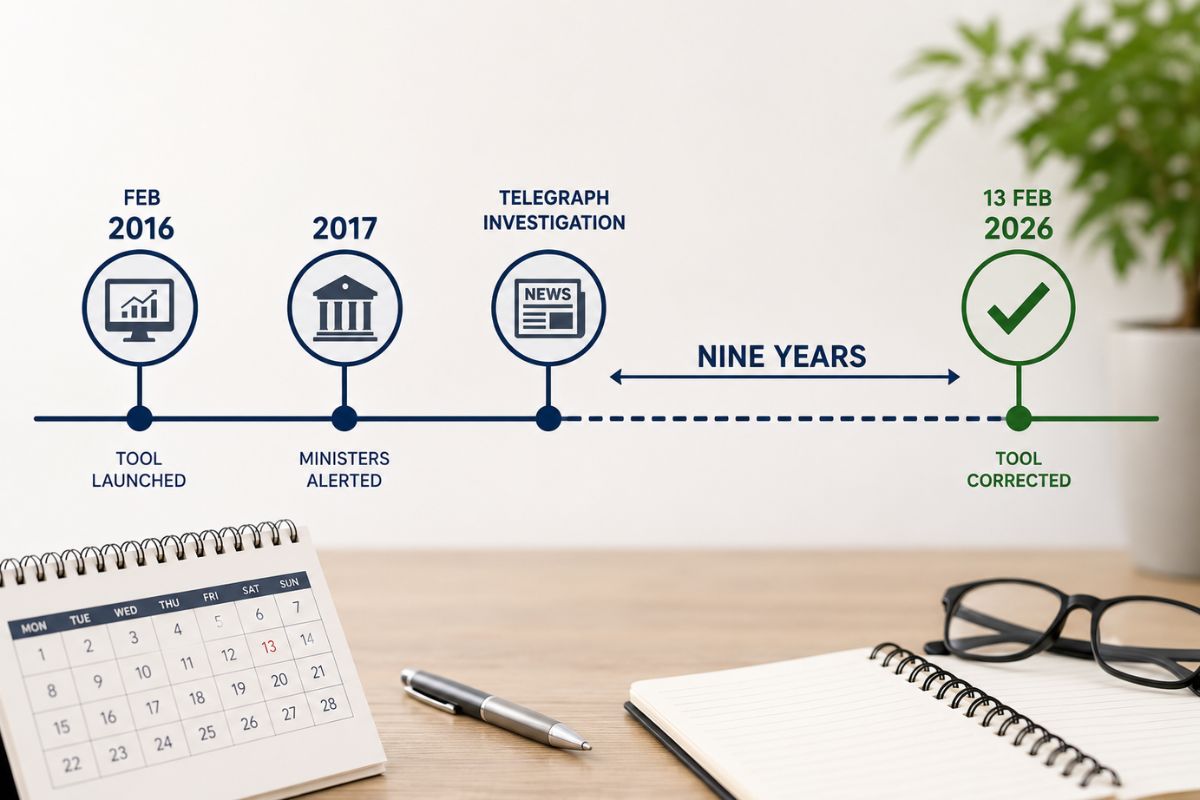
HMRC corrected an error in its online State Pension forecast tool on 13 February 2026, nine years after the tool launched. Reports indicate up to 800,000 people who had contracted out of the additional State Pension received forecasts that were too high. Payments were not affected. If you checked your forecast before 13 February 2026, check it again.
The error did not change anyone’s actual pension. It changed what people were told to expect, which for a decade was the number they planned around.
What went wrong
HMRC launched the “Check your State Pension” service in early 2016, alongside the new State Pension. The idea was straightforward: log in, see what you are on track to receive, and decide whether to top up your National Insurance record.
The tool did not correctly account for people who had been contracted out of the additional State Pension.
Contracting out ran until April 2016. If you were in certain workplace or public sector pension schemes, you and your employer paid reduced National Insurance, and in exchange part of your pension came from the scheme rather than from the state. Because you paid less in, your State Pension entitlement carries a deduction.
For a group of users, the forecast tool did not apply that deduction. It showed them the figure they would have received had they never contracted out.
HMRC corrected the tool on 13 February 2026 and apologised.
Who was affected
Reporting on the correction indicates up to 800,000 people may have seen an inflated forecast, specifically those who contracted out and who reach State Pension age after April 2029.
According to the Telegraph investigation that prompted the fix, around 360,000 incorrect estimates were issued in the tool’s first three years alone, and ministers were alerted to the problem as early as 2017. The gap between that alert and the February 2026 correction is where the “nine-year” description comes from.
You are more likely to be affected if you:
- Worked in the public sector before April 2016, particularly the NHS, teaching, the civil service, the police or the armed forces
- Were in a defined benefit workplace scheme before April 2016
- Have “COPE” or contracted-out equivalent pension references on old statements
- Reach State Pension age after April 2029
If you have never been in a workplace pension scheme before 2016, or you reach State Pension age before April 2029, this is unlikely to concern you.
What it did not do
This matters, and the coverage has been muddy about it.
Nobody’s pension was reduced. The error was in the forecast, not in the entitlement calculation or the payment system. People already receiving a State Pension were paid correctly throughout.
No money was taken back. There is no overpayment to repay.
The entitlement did not change. What changed is the number on the screen. Someone whose true entitlement was always £200 a week was shown a higher figure. Their entitlement was always £200.
The harm is decision harm. People used the forecast to decide whether to keep working, whether to buy voluntary National Insurance years and how much to save privately. A forecast that was too high pointed all three decisions the wrong way.
How to check whether yours was wrong
There is a simple test.
Step 1. Find any State Pension forecast you obtained before 13 February 2026. A screenshot, a printout, a saved PDF or a figure written down.
Step 2. Get a current forecast from the Check your State Pension service on GOV.UK. You will need a GOV.UK One Login or Government Gateway account.
Step 3. Compare the two.
If the new figure is lower, your original forecast was affected. If they match, it was not.
If you have no record of the old figure, you cannot run the comparison, but you can still check whether you are exposed: look at whether your National Insurance record shows contracted-out years, and check your State Pension age. Both are shown in the same service.
What you can do about a shortfall
If your forecast has fallen, you have a gap between what you expected and what you will get. There are recognised routes to close it. Which is right depends entirely on your circumstances.
Fill National Insurance gaps. You normally need 35 qualifying years for the full new State Pension and at least 10 to get anything. Voluntary Class 3 contributions can fill missing years. There are deadlines on how far back you can go, and buying a year does not always increase your pension, particularly for people with contracted-out deductions. Check on GOV.UK before paying anything.
Reconsider your retirement date. Working longer adds qualifying years and shortens the period your savings must cover.
Consider deferral. Delaying your State Pension increases the eventual weekly amount. Whether that is worthwhile depends on your health, your other income and how long you expect to draw it.
Increase private pension contributions, if you have the capacity and time.
Get regulated advice. For a decision of this size, an FCA-regulated adviser can model your position properly. Pension Wise, the government’s free guidance service, is available from age 50.
This article explains what happened and what your options are. It is information, not financial advice, and does not recommend any course of action or provider.
What the State Pension pays now
| Rate | 2026/27 weekly | 2026/27 annual |
|---|---|---|
| Full new State Pension | £241.30 | £12,547.60 |
| Full basic State Pension | £184.90 | — |
Source: House of Commons Library, Benefits Uprating 2026/27. Rates rose 4.8% from April 2026 under the triple lock.
Some coverage of this story still quotes £230.25 a week. That was the 2025/26 rate and it is out of date.
Frequently asked questions
What was the HMRC state pension error?
The online forecast tool failed to apply the deduction owed by people who had contracted out of the additional State Pension, so it showed forecasts that were too high. HMRC corrected it on 13 February 2026.
How many people were affected?
Reports indicate up to 800,000, specifically people who contracted out and who reach State Pension age after April 2029.
Was my State Pension actually reduced?
No. The error was in the forecast only. Pensions in payment were calculated and paid correctly.
What does contracted out mean?
Before April 2016 you could pay reduced National Insurance if part of your pension came from a workplace scheme instead of the state. Those years carry a deduction from your State Pension.
How do I check my State Pension forecast?
Use the Check your State Pension service on GOV.UK. You will need a GOV.UK One Login or Government Gateway account.
Can I get compensation?
No compensation scheme has been announced. If you believe you suffered financial loss because of the error, you can complain to HMRC and then, if unresolved, to the Parliamentary and Health Service Ombudsman through your MP.
Should I buy voluntary National Insurance years?
It depends on your record and your State Pension age, and for people with contracted-out deductions extra years do not always increase the pension. Check on GOV.UK or speak to Pension Wise before paying.
How we reported this
Current State Pension rates come from the House of Commons Library’s Benefits Uprating 2026/27 briefing. Details of the tool error, the correction date and the number of people affected come from HMRC’s February 2026 statement as reported by GB News, the Telegraph and other outlets, and are attributed as reported rather than independently confirmed by us.
We have asked HMRC for the current number of affected users and whether any redress is planned. This article will be updated with its response.
Sources and References:
- House of Commons Library, Benefits Uprating 2026/27 (CBP-10403) — current rates
- Check your State Pension forecast service
- HMRC statement of 13 February 2026 (via GB News, Telegraph, Birmingham Live)
- Telegraph investigation into the forecast tool



Leave a Reply