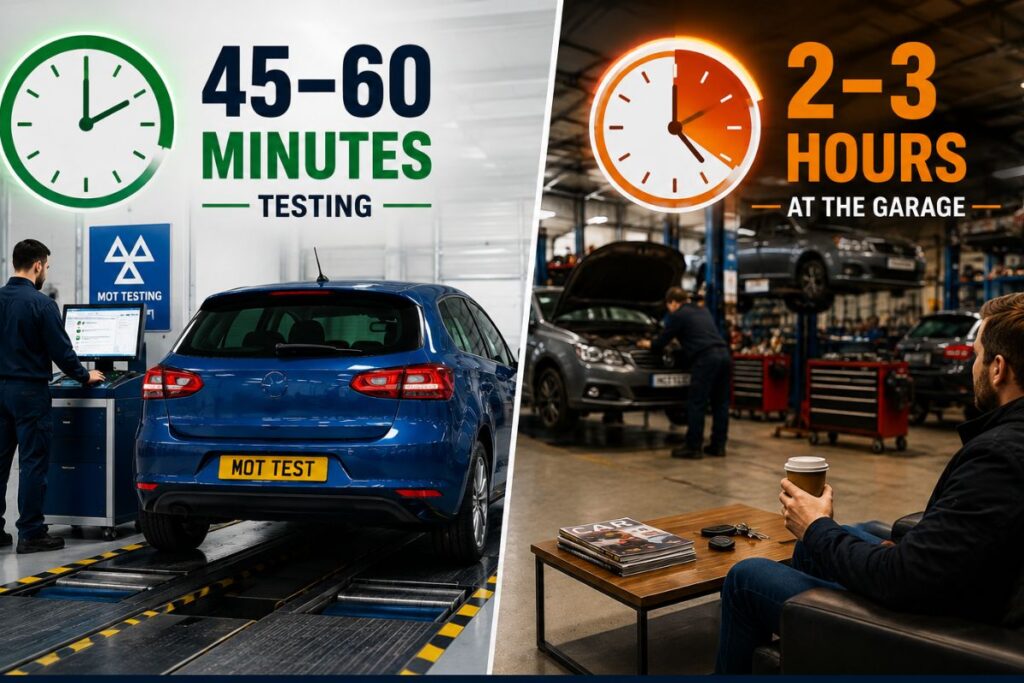
A standard car MOT usually takes 45 to 60 minutes of actual testing time. A motorcycle takes around 20 to 30 minutes. There is no legally fixed duration. Most garages ask you to leave the car for two to three hours, because the test slot and the queue are different things.
That gap between test time and garage time is what catches people out.
Test time against garage time
| Typical testing time | Typical time at the garage | |
|---|---|---|
| Car (Class 4) | 45 to 60 minutes | 2 to 3 hours |
| Motorcycle (Class 1 and 2) | 20 to 30 minutes | 1 to 2 hours |
| Large van (Class 7) | 45 to 60 minutes | 2 to 3 hours |
ESTIMATE. No regulation sets an MOT duration. These are typical ranges based on the scope of the DVSA inspection, not published figures.
The test itself is one tester, one vehicle, one ramp. The wait around it is scheduling. A garage running four ramps and a booking every half hour will hand your keys back faster than a single-ramp independent with a queue, even though the test is identical.
If you need the car back quickly, ask for the first slot of the day. Ask how many testers are on. Ask whether they will call you or whether you are expected to wait.
What makes a test take longer
Some of these are legitimate. Knowing which is useful.
Legitimate: – Car breaks early on something that needs more investigation – Testing emissions of older diesels which may require multiple attempts – Proper inspection of brakes so wheels need to be removed – A modified/unusual car which the tester needs to refer to the instructions – Motor caravans, the installation of habitation equipment is checked
Not regarding your car: – 1 tester in the garage and 3 cars scheduled – Your slot isn’t really your slot and the automobile is queued – The tester gets interrupted by other work
A exam lasting four hours is not a better test. It’s a more busy garage.
What should you do before taking your car for an MOT?
A few simple checks before the appointment can help avoid an unnecessary failure and may also make the test process smoother. Check that all lights work, the windscreen has no serious damage in the driver’s view, the tyres are properly inflated and the registration plates are clean and readable.
It is also worth checking the horn, windscreen washers and wipers, seatbelts and mirrors. Remove anything from the boot or passenger area that could prevent the tester from accessing parts of the vehicle.
These checks do not guarantee a pass, because an MOT covers many components that cannot be assessed properly without specialist equipment. The DVSA inspection manual sets out the items and defect standards that testers must follow.
When is your MOT actually due
Your MOT certificate is valid for 12 months from the date of the test.
The first MOT is due when the vehicle is three years old. Some vehicles, including taxis, private hire cars and ambulances, need one after one year because of how intensively they are used.
Vehicles built or first registered more than 40 years ago are generally exempt, though the owner remains responsible for keeping them roadworthy.
You can check your exact due date free on the GOV UK MOT history service using the registration.
The one-month-minus-a-day rule
This is worth understanding, because getting it wrong costs you days of cover every year.
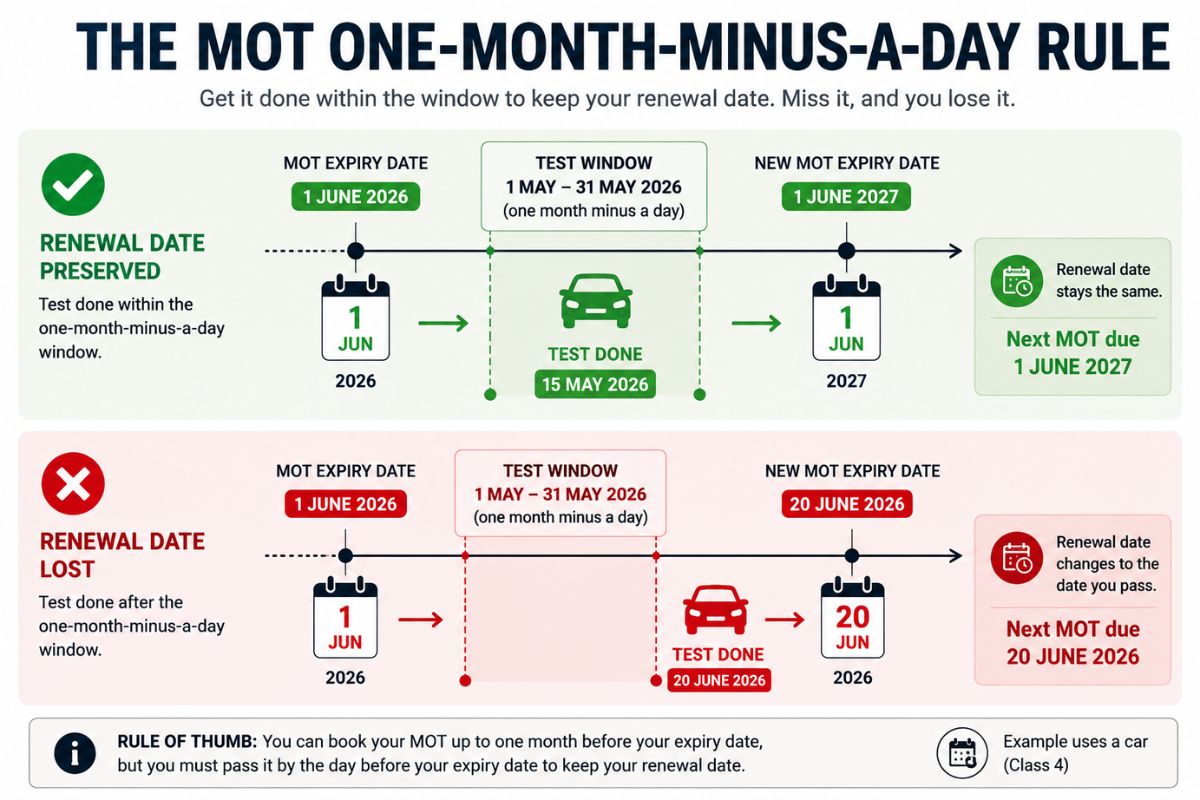
You can take the MOT up to one calendar month minus one day before it expires and keep your existing renewal date.
If your MOT runs out on 15 September, you can test from 16 August onwards, and the new certificate still runs to 15 September the following year. Test on 15 August and you lose a day. Test in July and the new expiry becomes twelve months from the test date, so you have shortened your own cycle.
Do it right every year and the date never drifts. Do it wrong once, and it drifts permanently.
Can you drive without a valid MOT
Generally no, with two exceptions.
You may drive to a pre-booked MOT appointment, and you may drive to a garage for repairs following a failure. In both cases the journey must be direct, and your insurance must still be valid, which is worth checking because some policies treat this differently.
Driving without a valid MOT otherwise carries a fine. Driving a vehicle in a dangerous condition carries a higher penalty and can bring penalty points and disqualification.
VERIFY at review — confirm current maximum fine amounts on GOV UK before publication. No figures are published in this draft.
Pass, fail, and the bit in between
Three outcomes, and the middle one confuses people most.
Pass. You get a certificate valid for 12 months.
Pass with advisories. You still pass. The certificate is valid. Advisories are items the tester has noted as wearing but not yet failing, such as tyres approaching the limit or light corrosion. They are not faults you must fix, but ignoring them usually means failing next year. Advisories appear on your public MOT history.
Fail. The certificate is not issued and the failure is recorded on the DVSA database immediately. If your old certificate has already expired, you cannot drive the car away except to a pre-booked repair.
There is a further distinction on failures. Dangerous defects mean the vehicle must not be driven at all until repaired. Major defects mean it fails but may in some circumstances be driven for repair if the previous certificate is still valid. Ask the tester which category applies before you move the car.
What happens if your car fails its MOT?
A failed MOT does not always mean you have to pay for another full test. What happens next depends on where the repairs are carried out and when the vehicle is returned for a retest.
If the vehicle stays at the same MOT test centre for repairs and is retested within 10 working days, a partial retest can be available without another full test fee. There are also certain items that qualify for a free partial retest if the vehicle is returned to the same test centre by the end of the next working day.
If you take the vehicle away for repairs, you can return it to the same test centre within 10 working days for a partial retest, although a fee may apply. In other circumstances, you may need a full MOT test and the full test fee again.
Before driving a failed vehicle away, check the reason for the failure. GOV.UK says you can take it away if the current MOT is still valid and it has no dangerous defects. If those conditions do not apply, the vehicle needs to be repaired before it can be driven.
Frequently asked questions
How long does a car MOT take?
Usually 45 to 60 minutes of testing. Most garages ask you to leave the car for two to three hours because of scheduling.
How long does a motorcycle MOT take?
Around 20 to 30 minutes, because the inspection covers fewer items.
Can I wait while my MOT is done?
Many garages allow it, but ask when booking. A test that runs to an hour still means a longer wait if the car is queued first.
How early can I get my MOT done?
Up to one calendar month minus one day before expiry, keeping your existing renewal date.
When does my MOT run out?
Check for free on the GOV UK MOT history service using your registration.
Can I drive to an MOT without a valid certificate?
Yes, if the test is already booked and you drive directly there. The same applies to driving to a garage for repairs after a failure.
Does a longer test mean a more thorough one?
No. The inspection is defined by the DVSA manual and is the same everywhere. A long wait usually means a busy garage.
What is an advisory?
An item the tester has noted as wearing but not yet failing. It does not stop you passing, and it appears on your public MOT history.
How we checked this
MOT validity, first-test ages, the exemption for vehicles over 40 years old, the early-testing rule and the rules on driving to a booked test all come from GOV UK’s Getting an MOT guidance. The scope of the inspection comes from the DVSA MOT Inspection Manual. Due dates and advisory history come from the GOV UK MOT history service.
Test durations are labelled as estimates because no regulation sets an MOT duration. Any page giving you a single fixed number is guessing with more confidence than the evidence supports.
Sources and References:
- GOV UK, Getting an MOT
- DVSA MOT Inspection Manual for Private Passenger and Light Commercial Vehicles
- GOV UK, Check the MOT history of a vehicle
- GOV UK, Driving without an MOT




Leave a Reply