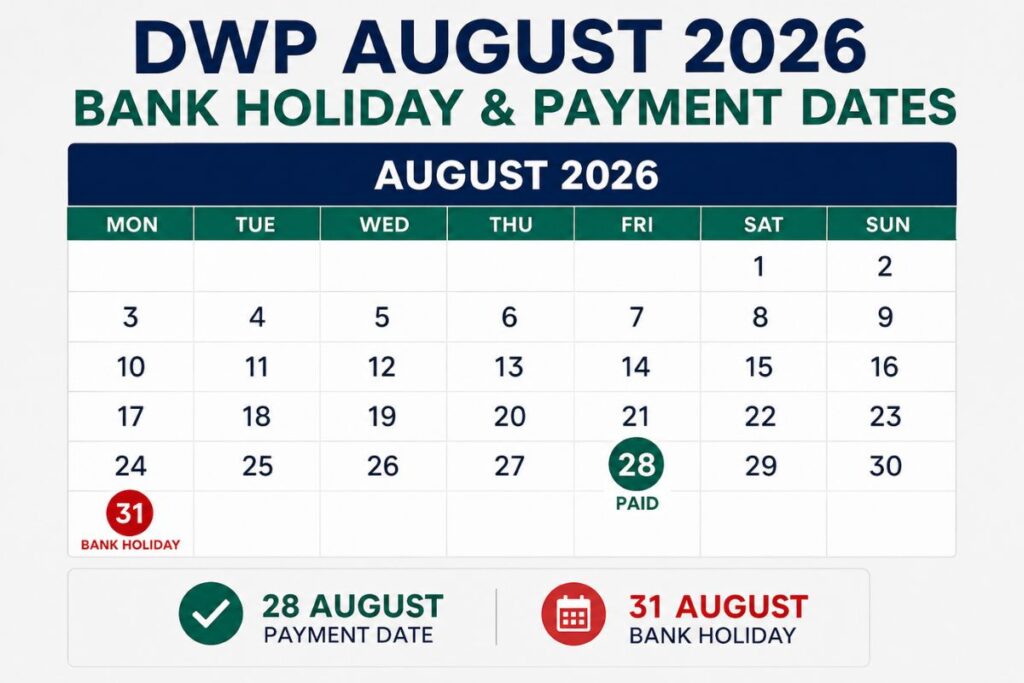
Benefit payments due on Monday 31 August 2026 will be paid on Friday 28 August 2026 instead. This affects Universal Credit, State Pension, PIP and most other DWP and HMRC payments in England, Wales and Northern Ireland. The amount does not change, and your next payment date does not change. Bank holiday dates from GOV.UK, verified 11 August 2026. If your payment normally lands on a different day, nothing changes. Only payments falling on the bank holiday itself move.
When you will be paid
| Payment normally due | You will be paid |
|---|---|
| Monday 31 August 2026 | Friday 28 August 2026 |
| Saturday 29 or Sunday 30 August | Friday 28 August 2026 |
| Any other date | No change |
Monday 31 August 2026 is the summer bank holiday in England, Wales and Northern Ireland. Banks and DWP offices close, so payments cannot be processed. The DWP moves them to the last working day before, which is Friday 28 August. You do not need to do anything. The shift happens automatically for every affected claimant.
This is not extra money
Read this part before you spend it. An early payment is the same payment, arriving sooner. It is not a bonus, not a cost of living payment and not an additional award. Your next payment arrives on its normal date, which means the gap between this payment and the next one is longer than usual. If you are paid monthly and your money arrives on Friday 28 August instead of Monday 31 August, you are covering the same period with the same amount, starting three days earlier. Budget for the longer stretch.
There is a second thing worth knowing. If your payment date sits at the end of the month, an early payment can land in the previous calendar month. Two payments can appear in one month and none in the next. Your entitlement has not changed. Check the assessment period on your statement rather than counting deposits.
Will an early payment change your benefit schedule?
No. A bank holiday adjustment changes the date on which the money reaches your account, but it does not permanently change your benefit payment schedule. For example, if your payment due on Monday 31 August 2026 arrives on Friday 28 August, your following payment remains due on its usual date.
For Universal Credit, your regular payment date is based on your assessment period and payment schedule. The bank holiday does not reset that cycle. This is why an early payment can make the gap between two deposits look longer than normal even though your entitlement and assessment period have not changed.
Which benefits are affected
The shift applies to payments administered by both the DWP and HMRC:
- Universal Credit
- State Pension
- Pension Credit
- Personal Independence Payment (PIP)
- Attendance Allowance
- Carer’s Allowance
- Disability Living Allowance
- Employment and Support Allowance
- Income Support
- Jobseeker’s Allowance
- Child Benefit
- Tax Credits
If your normal payment date is not Saturday 29, Sunday 30 or Monday 31 August, your payment arrives as usual.
What if you are paid weekly, fortnightly or every four weeks?
Not every benefit follows a monthly payment pattern. Some benefits are paid weekly, fortnightly or every four weeks, so the effect of a bank holiday depends on whether the scheduled payment date falls on the affected weekend or Monday. The same basic rule applies: a payment due on a non-working bank holiday is normally brought forward to the preceding working day.
If your payment normally arrives on a different day, there is no general reason to expect it to move simply because the August bank holiday is approaching. Check your usual payment date and the relevant GOV.UK guidance rather than assuming that every benefit is being paid early.
Scotland is different, and this catches people out
Scotland’s summer bank holiday fell on Monday 3 August 2026, the first Monday of the month. England, Wales and Northern Ireland observe the last Monday, which is 31 August. The two are separate holidays, not the same holiday on different days. What matters for your payment is where the DWP processes it, which follows the England and Wales banking calendar for reserved benefits. Scottish claimants of Universal Credit, State Pension and PIP should expect the same Friday 28 August shift. If you are unsure, the date shown in your online journal already reflects the correct adjustment. Trust the journal over any calendar.
What happens for the rest of 2026
Two more bank holiday shifts are coming, and the Christmas one is unusual.
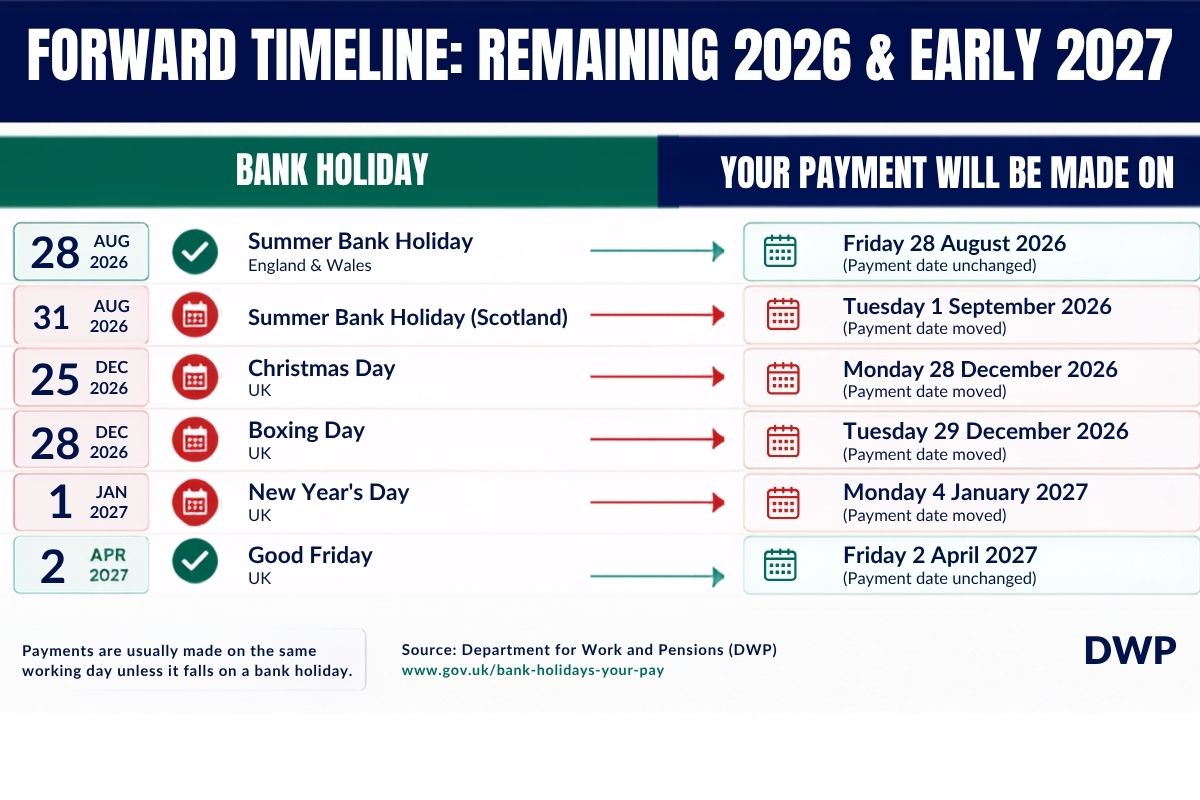
| Bank holiday | Date | Payments due then arrive |
|---|---|---|
| Summer bank holiday | Mon 31 Aug 2026 | Fri 28 Aug 2026 |
| Christmas Day | Fri 25 Dec 2026 | Thu 24 Dec 2026 |
| Boxing Day (substitute) | Mon 28 Dec 2026 | Thu 24 Dec 2026 |
| New Year’s Day | Fri 1 Jan 2027 | Thu 31 Dec 2026 |
Christmas 2026 falls awkwardly. Christmas Day is a Friday and Boxing Day is a Saturday, so the Boxing Day holiday moves to Monday 28 December. Anyone due on either Friday 25 or Monday 28 December is paid on Thursday 24 December. That produces the longest gap of the year. A payment received on Christmas Eve may need to last until well into January. Plan for it now rather than in the third week of December. Scottish claimants have one extra date. The 2nd January holiday moves to Monday 4 January 2027, because 2 January is a Saturday.
If your payment does not arrive
Work through these in order.
Check the day. If your payment was due on a weekend or a bank holiday, it should have arrived on the working day before, not after.
Check your online account. Your Universal Credit statement shows the payment date, the amount and any deductions. A change you were not expecting usually appears here first.
Check for messages. The DWP or HMRC may have written, texted or left a message in your online account asking for information.
Check with your bank. Most payments clear shortly after midnight on the due date, but processing times vary between banks, and some show funds as pending before they are available.
Then contact the office responsible. DWP offices and phone lines are closed on the bank holiday itself, so calling on Monday 31 August will not reach anyone. Contact details for every benefit are on GOV UK.
Frequently asked questions
Will I get paid early because of the August bank holiday?
Only if your payment is due on Saturday 29, Sunday 30 or Monday 31 August 2026. Those payments arrive on Friday 28 August. Any other date is unaffected.
Is the early payment extra money?
No. It is the same payment arriving sooner. Your next payment date does not change, so the gap after it is longer than usual.
Does my next payment date change?
No. Your schedule returns to normal immediately.
What time will the payment arrive?
Most DWP and HMRC payments clear shortly after midnight on the payment date, though the exact time depends on your bank.
Do I need to tell the DWP or apply for this?
No. The adjustment is automatic for everyone affected.
Does this apply to Scotland?
Scotland’s own August bank holiday was 3 August 2026, but reserved benefits follow the same processing calendar, so the Friday 28 August shift applies. Check your journal to confirm.
When will benefits be paid over Christmas 2026?
Payments due on Friday 25 December or Monday 28 December will arrive on Thursday 24 December. Payments due on Friday 1 January 2027 arrive on Thursday 31 December 2026.
How we checked these dates
Bank holiday dates come from the GOV UK bank holidays dataset, the government’s official record. Each payment shift was calculated independently by working back to the last working day before the holiday, rather than copied from another publication. During checking, we found a published claim elsewhere that New Year’s Day 2027 falls on a Thursday. It is a Friday.
Sources and References:
- GOV UK bank holidays dataset
- GOV UK benefit payment dates guidance
- House of Commons Library, Benefits Uprating 2026/27 (CBP-10403)
- DWP statements to media on previous bank holiday shifts
December 2026. If your payment has not arrived and you are struggling, contact your benefit office as soon as possible. Citizens Advice offers free, independent help with benefit problems.



Leave a Reply