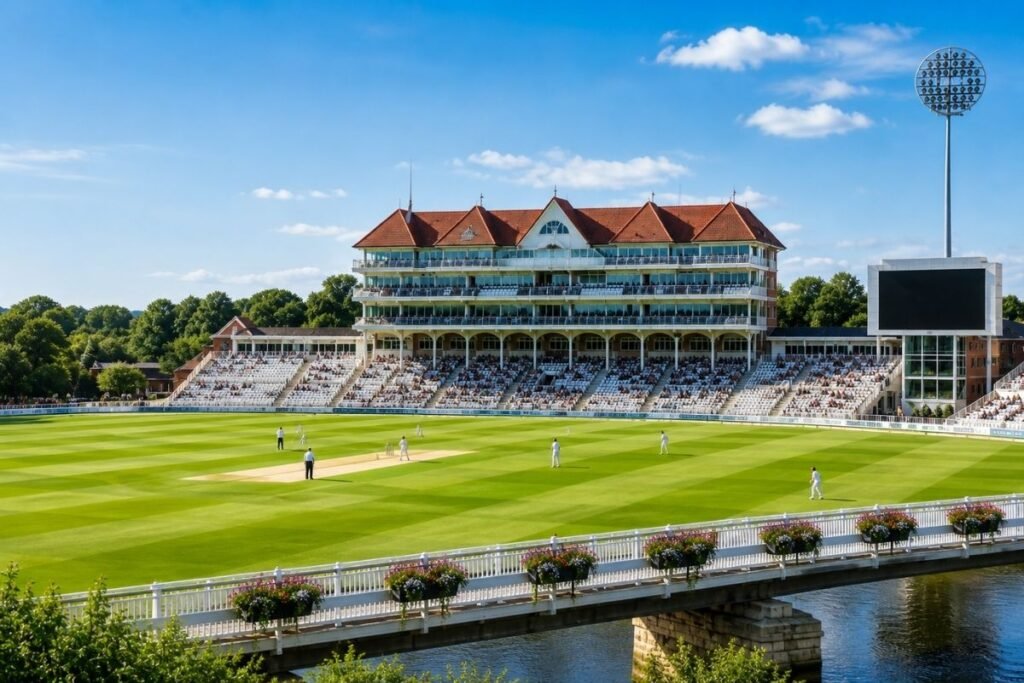
Just south of Nottingham, across the River Trent in West Bridgford, sits one of English cricket’s most storied grounds. Trent Bridge has been Nottinghamshire County Cricket Club’s home since 1838, and it’s hosted international cricket since England first played a Test there against Australia in 1899. More than a century on, both are still true — England still turns up for internationals, and Notts still plays its county fixtures on the same turf.
Where is Trent Bridge?
The ground’s address is West Bridgford, Nottinghamshire, NG2 6AG — about two miles from Nottingham city centre and roughly a mile from the railway station. A handful of other major Nottingham sporting venues are nearby too.
You’ll find the main approaches via Bridgford Road, Radcliffe Road, Hound Road and Fox Road. One thing worth flagging: parking, entry rules and transport advice all shift depending on the fixture, so it’s worth checking the official arrangements for your specific match day rather than relying on general directions.
Also Read: Most Loyal Football Fans UK 2026: Who Tops the List?
How it all started
The ground exists because of one man: William Clarke, a name still central to early Nottingham cricket history.
Clarke married Mary Chapman — landlady of the Trent Bridge Inn — in December 1837, moved into the inn, and turned the adjoining meadow into an enclosed cricket ground. The first match there was played in May 1838, and later that season Clarke himself scored 128 for Holme Lane against Bingham, an innings Trent Bridge still records as the ground’s first century. Contemporary accounts credited him with laying out and maintaining the new venue well.
Cricket had actually been played in the area long before 1838 — but that’s the year Clarke enclosed the field specifically for the sport, which is why it’s the date most people cite as the ground’s founding.
William Clarke’s legacy
Clarke became so central to Nottingham cricket in the 1830s that Trent Bridge still refers to him as the “Father of Trent Bridge.”
It wasn’t a small shift, either. Cricket on the Forest — the previous home of the game in Nottingham — had always been free to watch. Clarke’s ground charged admission, which was a genuine gamble at the time. And it didn’t pay off immediately: by Trent Bridge’s own account, only a handful of major matches were staged there during Clarke’s years in charge. Even so, the ground held on and eventually became established as the city’s cricketing home.
Clarke left for London in 1846 to work as a professional bowler at Lord’s, where he later founded the famous All-England Eleven. His name lives on at Trent Bridge in the William Clarke Stand, built in 1990.
Trent Bridge and Nottinghamshire cricket
The ground and the county grew up together. Nottinghamshire sides played significant matches through the 1830s, well before the county had any formal structure behind it — and as that structure developed, Trent Bridge became its natural home.
It’s never really stopped being a county ground first and foremost. Generations of Nottinghamshire supporters have watched domestic cricket there throughout the season, Test matches or not.
Also Read: Ranking the Top 10 Super Bowl Wins by Team
The first Test: 1899
Trent Bridge’s first Test came in 1899, against Australia, with the match starting on 1 June. It’s a fixture that gets remembered for a few reasons at once: it was the ground’s Test debut, it featured a touring Australian side, and it turned out to be WG Grace’s final Test appearance. Wilfred Rhodes and Victor Trumper both made their Test debuts in the same match.
That single game is really what turned Trent Bridge into an international venue — a role it’s held ever since.
Ashes history
The ground has produced its share of Ashes drama. In 2015, England bowled Australia out for just 60 in the first innings and went on to win by an innings and 78 runs — one of the more famous results in recent Ashes history.
Looking ahead, Trent Bridge will open the 2027 Men’s Ashes series, hosting England v Australia from 18–22 June 2027, according to the ECB’s current international schedule. Another chapter in a Test history stretching back to 1899.
Trent Bridge: Looking Ahead to 2027
Trent Bridge is set for another major moment in its long cricketing history when it hosts the opening Test of the 2027 Men’s Ashes series between England and Australia from 18–22 June. The fixture will bring one of cricket’s oldest rivalries back to Nottinghamshire, giving supporters another opportunity to experience international cricket at a ground that has welcomed Test matches since 1899. With its deep connection to county cricket and its reputation for memorable Ashes contests, Trent Bridge is once again preparing to take centre stage in English cricket.
What’s played there
Trent Bridge hosts a full mix of domestic and international cricket:
- Test matches
- One-Day Internationals
- T20 Internationals
- County Championship cricket
- One-Day Cup matches
- Domestic T20
It’s also used when Nottingham hosts major international tournaments.
What sets Trent Bridge apart
Part of what makes the ground distinctive is that it doesn’t feel like a stadium built purely for international cricket that happens to also host county games — it’s the reverse. Nottinghamshire still treats it as home, and you’ll notice the difference: turn up for a county match and the atmosphere is a world away from an Ashes Test, even though you’re sitting in the same seats.
The history is visible too, not just written down. The William Clarke Stand ties the ground back to the man who built it, and the connection to past Nottingham and England players is still very much part of its identity — all while remaining a working international venue right on the edge of the city, beside the river.
Getting there
By train — Nottingham station is about a mile away; walk it or pick up local transport for the rest.
By tram — Trams run towards the ground as well, though it’s worth checking the current route and the walk from your stop before match day.
By car — Arrangements vary by fixture, and while match-day parking is sometimes available at designated spots, check Trent Bridge’s official information rather than assuming general parking advice applies.
Where to sit — The ground has several stands, each with its own character: the William Clarke Stand, the Hound Road Stand, the Bridgford Road Stand, and other areas besides. Seating and facilities can change between fixtures, so it’s worth checking the official seating info before you book.
Quick facts
| Detail | Information |
|---|---|
| Location | West Bridgford, Nottinghamshire |
| Postcode | NG2 6AG |
| Ground established | 1838 |
| Founder | William Clarke |
| First Test | England v Australia, 1899 |
| Home county | Nottinghamshire |
| 2027 Men’s Ashes | England v Australia, 18–22 June |
| River | River Trent |
Common questions
When was Trent Bridge founded? William Clarke enclosed the field next to the Trent Bridge Inn in 1838 — the year most people credit, even though cricket had already been played nearby before that.
Who plays there? Nottinghamshire County Cricket Club calls it home, and England plays internationals there.
When was the first Test? 1899, against Australia — the ground’s first.
Is it hosting the 2027 Ashes? Yes — the ECB has it down as the opening venue, from 18–22 June.
How far is it from the city centre? About two miles, and roughly a mile from the train station.
Can you visit without a match on? Access and tours vary, so it’s best to check the official Trent Bridge website for current opening times and events.
Why it matters
What makes Trent Bridge stand out isn’t any single thing — it’s the continuity. A cricket ground founded in 1838, a first Test against Australia in 1899, generations of county cricket in between, and international fixtures still being played there today. Few English grounds tie a modern international match this directly back to the early days of the sport, and that thread is a large part of why Trent Bridge remains one of the country’s most recognisable venues.
Sources and References
Trent Bridge official club history




Leave a Reply