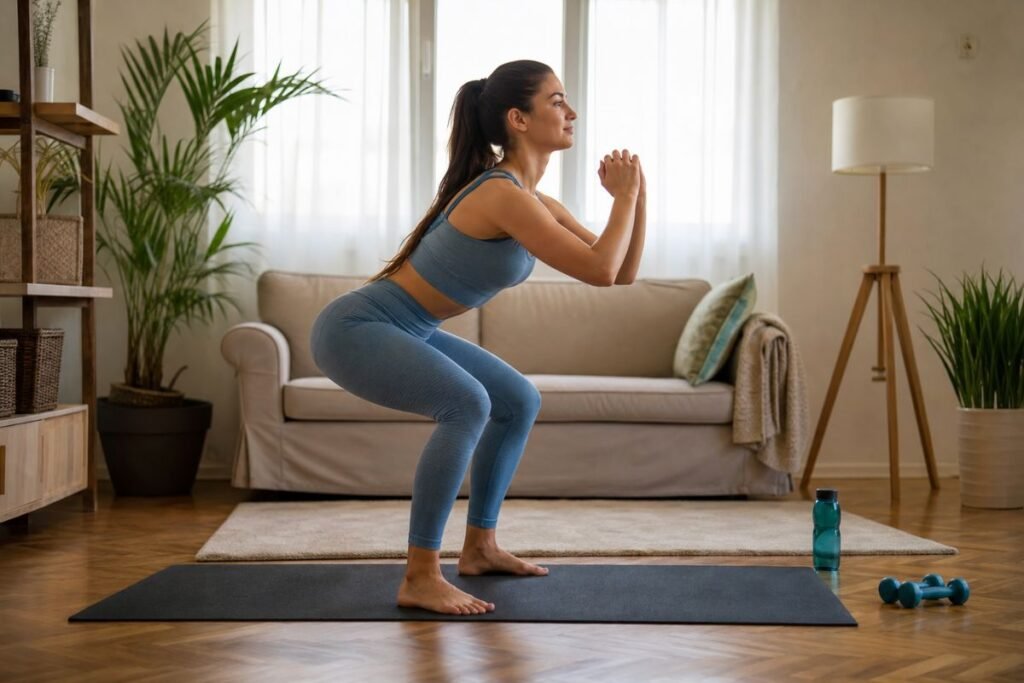
The best solo exercises you can do at home are squats, push-ups, lunges, glute bridges, planks, walking in place, step-ups, and other bodyweight motions. You can mix these exercises for a simple, complete body workout without a gym membership or fancy equipment.
The World Health Organization recommends that adults do at least 150 to 300 minutes of moderate-intensity aerobic activity a week, or 75 to 150 minutes of vigorous activity, including activities to strengthen the muscles of the major muscle groups at least two days a week.
Here, consistency is more crucial than the intensity. If you are currently inactive, WHO suggests that you start carefully and gradually increase the frequency, length and intensity rather than taking a big leap.
What Are the Best Solo Exercises at Home?
There’s no single “best” list — it depends on your fitness level and what you’re aiming for — but a well-rounded routine tends to include:
- Squats for the legs and glutes
- Push-ups for the chest, shoulders, and arms
- Lunges for the legs and balance
- Glute bridges for the hips and glutes
- Planks for the core
- Marching in place for low-impact cardio
- Jogging in place for cardiovascular fitness
- Step-ups for the legs and cardio
- Bird-dogs for core stability and balance
- Jumping jacks for higher-intensity cardio
- Mountain climbers, which combine cardio and core work
A well-rounded indoor routine touches on aerobic work, strength, flexibility and balance rather than just one of those.
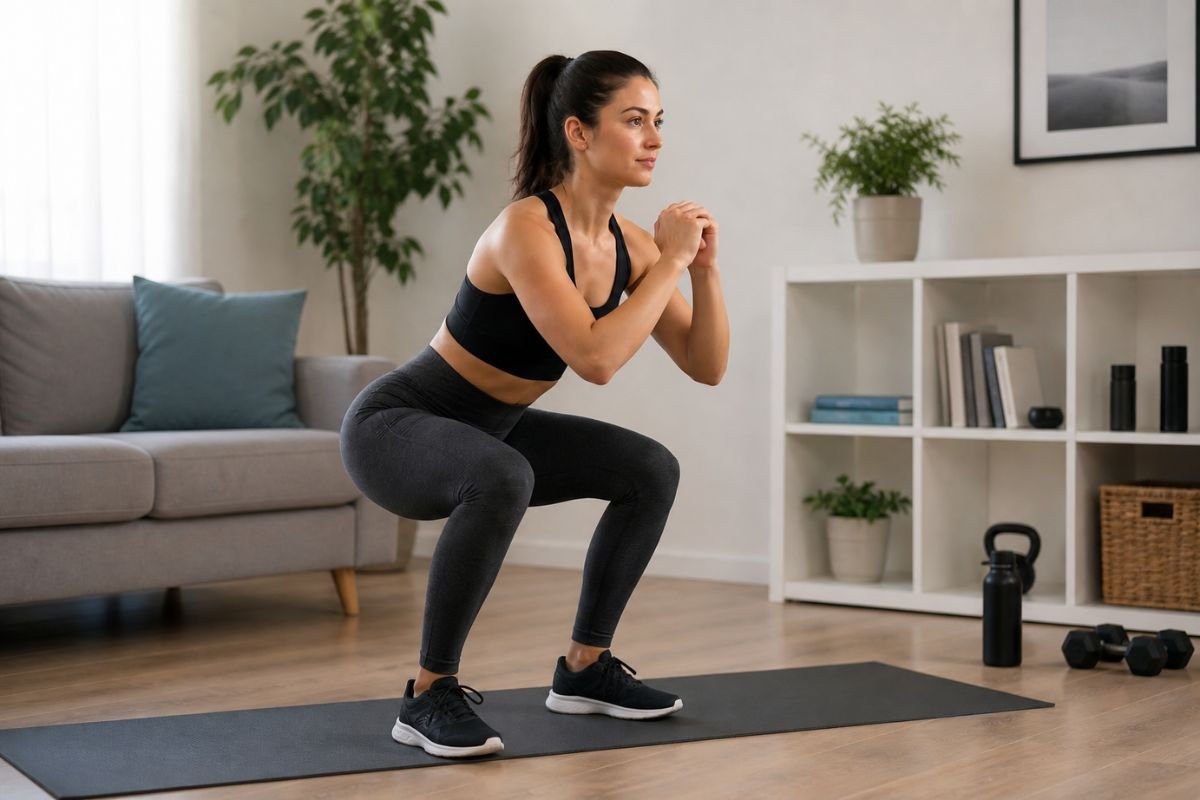
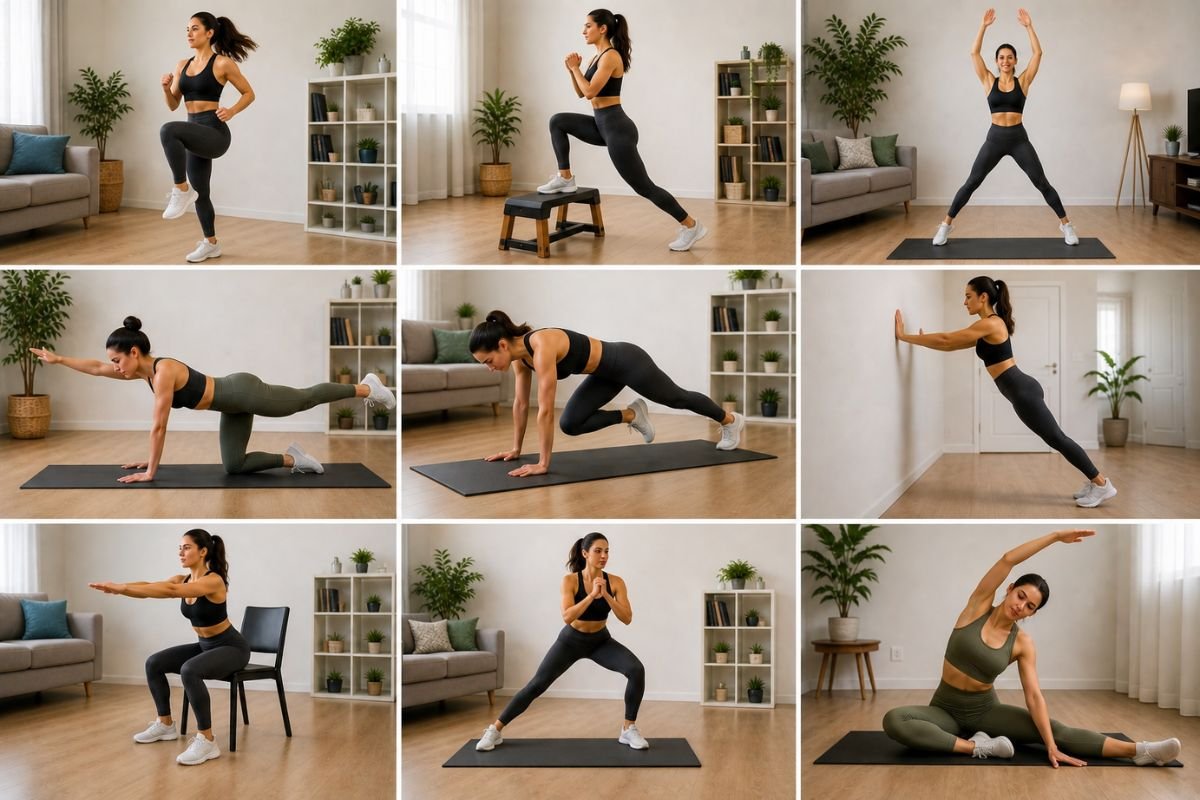
1. Bodyweight Squats
Squats are about as accessible as home exercise gets. They target the legs and hips, and you can scale the depth and pace to suit your level.
How to do squats
- Stand with your feet roughly shoulder-width apart.
- Keep your chest comfortably upright.
- Push your hips back and bend your knees.
- Lower yourself as far as feels controlled.
- Push through your feet back to standing.
Don’t chase reps early on — focus on keeping the movement controlled.
2. Push-Ups
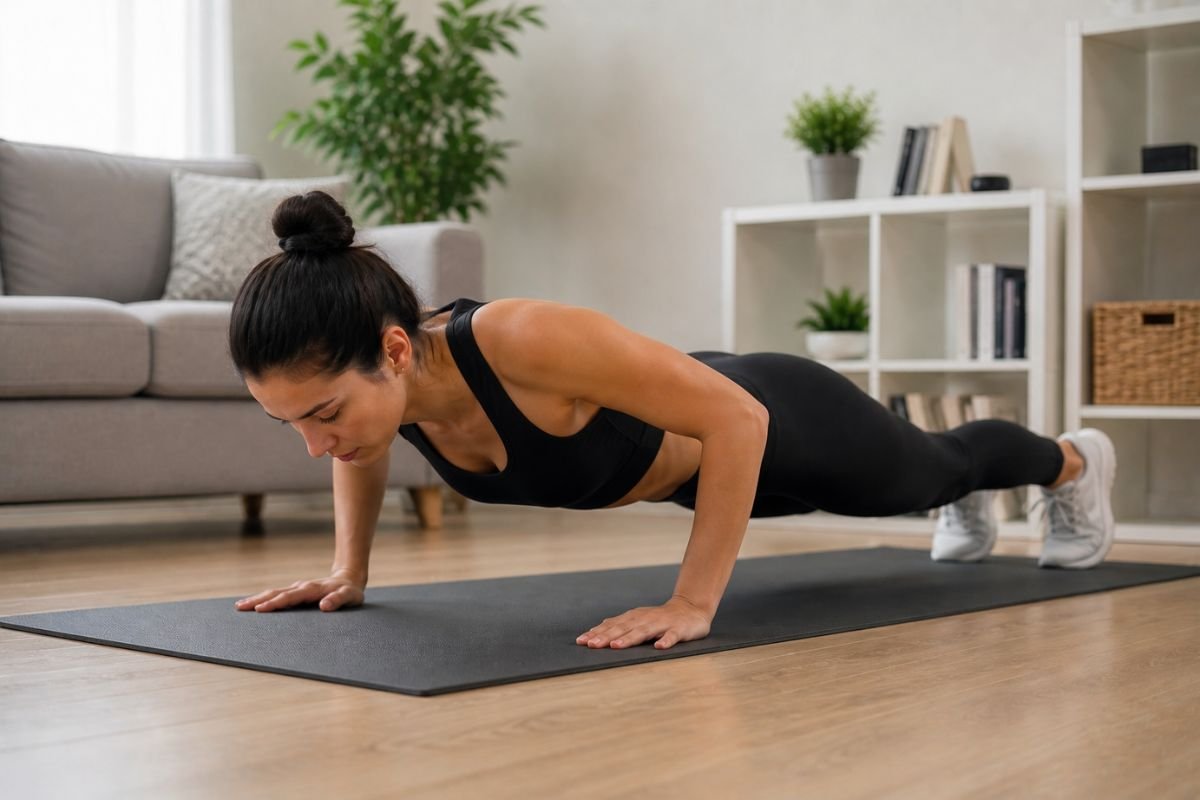
Push-ups hit the chest, shoulders, arms and core. If a floor push-up is too much right now, start against a wall or a raised, sturdy surface and work your way down.
Beginner progression
wall push-up → incline push-up → knee push-up → standard push-up
Focus on maintaining controlled movement rather than trying to complete as many repetitions as possible.
3. Reverse Lunges
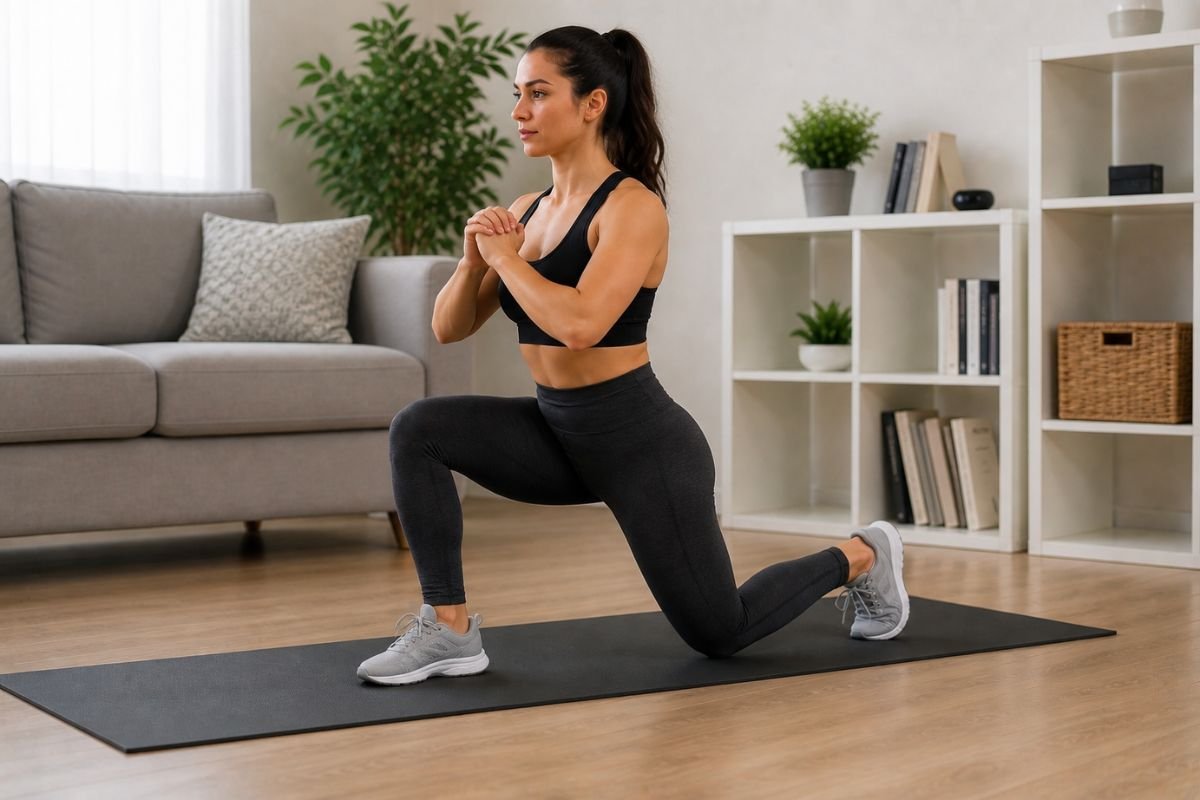
Lunges build leg strength while also testing balance and coordination. Reverse lunges — stepping backward instead of forward — tend to be more beginner-friendly.
How to do reverse lunges
- Stand upright.
- Step one foot backward.
- Bend both knees as you lower.
- Push through the front foot.
- Return to standing and repeat on the other side.
If balance is an issue, do these near something stable you can hold onto.
4. Glute Bridges
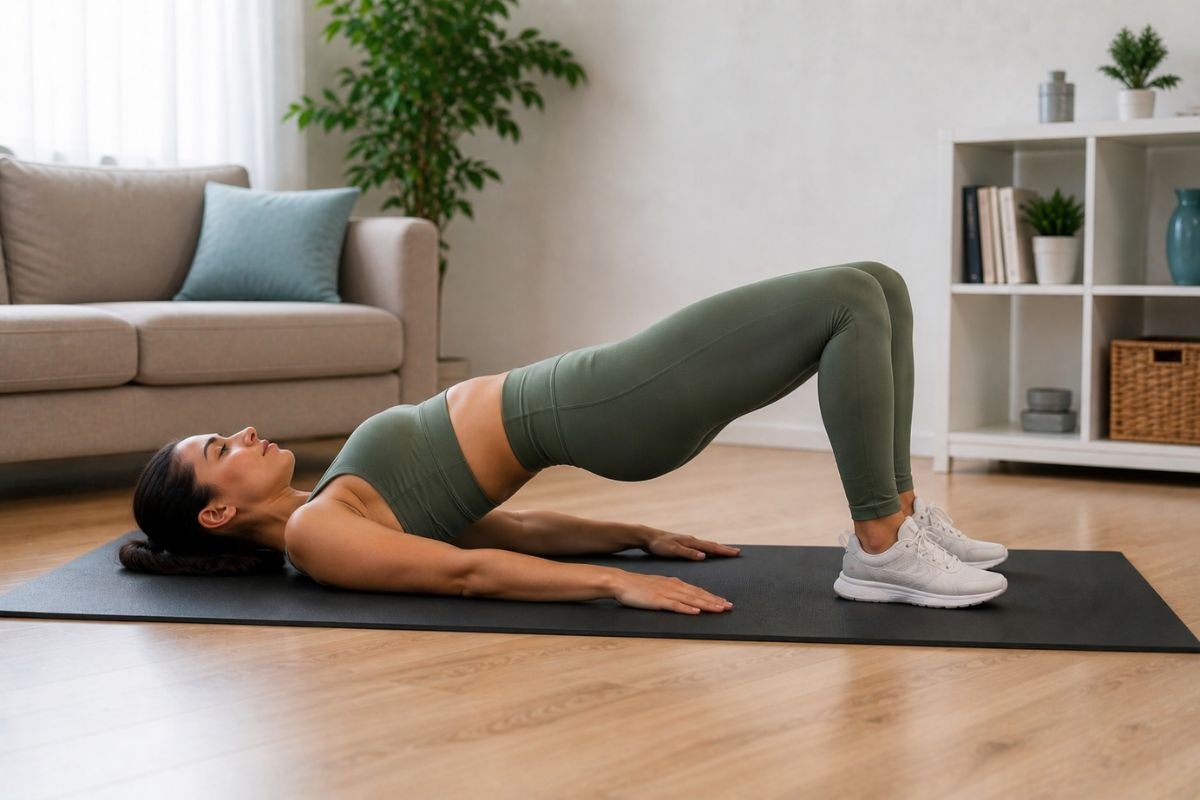
Glute bridges are performed on the floor and primarily work the glutes and muscles around the hips.
How to do a glute bridge
- Lie on your back.
- Bend your knees, feet flat on the floor.
- Arms relaxed at your sides.
- Raise your hips in a controlled motion.
- Pause briefly, then lower slowly.
There’s no need to rush this one.
5. Planks
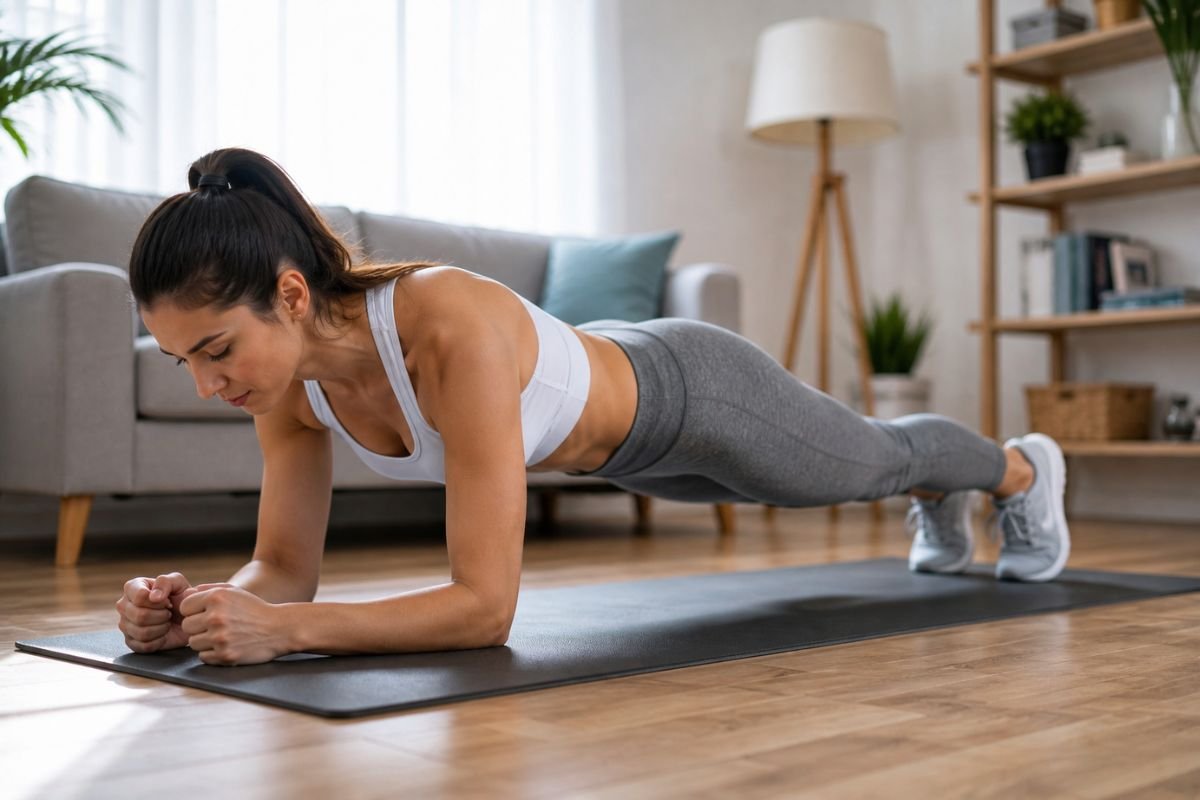
A simple, effective core exercise — and one where shorter, well-held sets beat long, shaky ones.
Basic plank
- Forearms on the floor.
- Legs extended behind you.
- Body kept roughly straight, core braced.
- Breathe normally throughout.
Struggling with a full plank? Drop to your knees and build from there.
6. Marching in Place
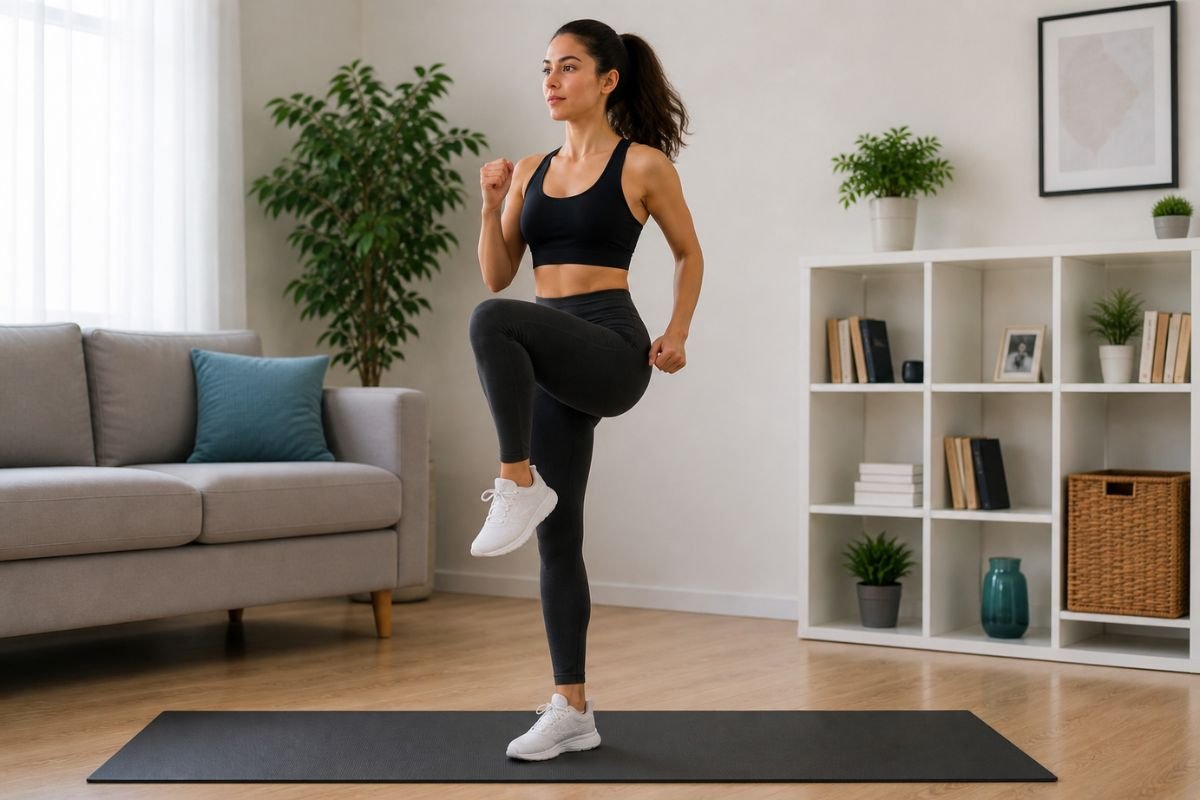
About as simple as solo exercise gets, and it barely needs any space.
Lift one knee at a time, swing your arms naturally, and pick up the pace once it feels easy.
It also works well as a warm-up before strength work.
7. Jogging in Place
Jogging in place provides a more vigorous option than marching.
Start at a comfortable pace and gradually increase intensity.
If jogging causes discomfort or you are not accustomed to impact exercise, use brisk marching or another lower-impact movement instead.
8. Step-Ups
Step-ups are a great way to combine lower body strength with cardio.
Only use a secure, steady step or stairway.
Place one foot on the surface, follow with the other foot, and then place down gently. Lead with the opposite leg.
Always use a stable chair, stool or other surface that cannot slip.
9. Jumping Jacks
Jumping jacks raise your heart rate fast and take up almost no room, though they come with more impact than marching.
For a gentler version, step your feet out to the side one at a time instead of jumping.
10. Bird-Dog
Bird-dogs build core control and balance at the same time.
How to perform a bird-dog
- Start on hands and knees.
- Extend one arm and the opposite leg.
- Hold briefly, then return.
- Switch sides.
Keep it slow and deliberate.
11. Mountain Climbers
Mountain climbers blend core work with a cardio hit. From a high-plank position, drive one knee toward your chest, return it, and alternate legs. Beginners can — and should — take these slowly; speed isn’t the point.
12. Wall Push-Ups
Wall push-ups are particularly suitable for beginners who cannot yet perform floor push-ups.
Stand facing a wall, place your hands against it and slowly bend your elbows to bring your body toward the wall. Push away to return to the starting position.
As your strength improves, you can progress to incline and floor push-ups.
13. Chair Squats
Chair squats can help make the squat easier to learn.
Stand in front of a strong chair and lower your hips toward the seat. If necessary, lightly touch the chair and return to standing.
Avoid a sliding or tipping chair.
14. Side Steps
Side steps are an easy, low-impact approach to stay active.
Side steps are an easy, low-impact approach to stay active. Step to the side, bring the other foot nearer you and keep switching.
As your fitness increases, you can raise your tempo or add arm movements. They are also helpful for breaks during lengthy periods of sitting.
15. Mobility and Stretching Exercises
Strength and cardio aren’t the whole picture.
Gentle mobility work and stretching before or after a workout matter too — MedlinePlus lists stretching alongside aerobic, strength and balance work as part of a well-rounded routine.
Just don’t force a stretch or bounce into it.
Best Solo Exercises for Different Goals
| Goal | Useful exercises |
|---|---|
| Leg strength | Squats, lunges, chair squats |
| Glute strength | Glute bridges, squats, lunges |
| Upper-body strength | Push-ups, wall push-ups |
| Core training | Planks, bird-dogs, mountain climbers |
| Low-impact cardio | Marching, side steps |
| Higher-intensity cardio | Jogging in place, jumping jacks |
| Balance | Lunges, bird-dogs, step-ups |
| Mobility | Gentle stretching and mobility exercises |
| Beginner workouts | Wall push-ups, chair squats, marching |
A Simple 20-Minute Solo Workout at Home
Not sure where to start? This basic structure works as a template.
Warm-up: 4 minutes
Move through each comfortably:
- March in place
- Arm circles
- Gentle knee lifts
- Easy bodyweight squats
Main workout: 12 minutes
About 40 seconds of work followed by 20 seconds of rest, for each of:
- Bodyweight squats
- Wall or floor push-ups
- Reverse lunges
- Glute bridges
- Marching or jogging in place
- Plank
Run through the circuit twice.
Cool-down: 4 minutes
Walk slowly around the room and ease into some comfortable stretching or mobility work.
This is just a starting template — scale down the duration or pick easier variations if you’re new to it.
How Often Should You Exercise at Home?
WHO’s guidance for adults is 150–300 minutes of moderate aerobic activity a week, or 75–150 minutes of vigorous activity, plus muscle-strengthening work covering the major muscle groups on at least two days a week.
You don’t need to hit that total in one or two long sessions — it can be spread across the week however suits you.
If you’re doing little to no exercise right now, WHO specifically recommends starting small and building from there rather than jumping straight into the full amount.
How to Make Home Workouts More Challenging
Once your current routine starts feeling easy, there are a few ways to push it further:
- Add repetitions
- Add another set
- Extend the duration
- Trim the rest periods slightly
- Try a harder variation
- Slow the reps down for more control
- Combine strength and cardio work
Not every session needs to be maxed out — progress just needs to be gradual and appropriate for where you’re at.
Common Mistakes to Avoid
Doing Too Much Too Soon
Jumping from no exercise to intense daily sessions makes a routine harder to sustain and raises injury risk. Ease in and build gradually.
Ignoring Exercise Technique
Form matters more than rep count. If your form starts slipping, slow down or switch to an easier variation.
Training Only One Muscle Group
A balanced routine covers the major muscle groups rather than fixating on abs, arms or legs alone — CDC guidance calls for strengthening work across the legs, hips, back, abdomen, chest, shoulders and arms.
Skipping Recovery
You don’t need a hard session every single day. Give your body time to recover, especially after tougher strength work.
Exercising Through Pain
Muscle fatigue and pain aren’t the same thing. MedlinePlus advises stopping if you feel pain, and avoiding sudden jumps in volume or intensity.
Also Read: Hidden Netflix Categories Most People Don’t Know About
Are Home Workouts Effective?
Yes — a complete routine is entirely possible without a gym or equipment. MedlinePlus notes that indoor workouts can cover aerobic exercise, stretching, strength and balance work.
What matters most is building a routine that fits your current ability and that you’ll actually stick with.
For some, bodyweight exercise alone is enough for general fitness. Others eventually add resistance bands, dumbbells or similar equipment for further progression.
Can You Build Muscle With Solo Exercises at Home?
Yes! Bodyweight training definitely qualifies as muscle-strengthening activity, as long as it’s hard enough for your current level.
You can develop squats, lunges and push-ups by increasing reps, moving to a harder version or adding resistance.
That said, how much muscle you can gain without equipment really depends on your starting place, the workout you’re doing, your diet, your recovery and how well you apply progressive stress.
Can You Lose Weight With Home Exercises?
Home workouts can add to your overall activity and energy expenditure, but weight management isn’t about exercise alone.
A sustainable approach usually pairs regular activity with sensible nutrition and other healthy habits — be wary of any exercise promising rapid or guaranteed weight loss.
Is It Better to Exercise Alone or at a Gym?
Neither is automatically better.
Home workouts suit you if convenience, privacy, cost or not having to travel matter most. A gym gives you access to more equipment and heavier resistance options.
The right choice is whichever one you can do safely and keep up with.
Safety Tips for Exercising Alone at Home
Before you start exercising, make sure you have enough area to move about safely, and that any furniture or equipment you use is stable.
A warm-up gets your body ready for activity and can assist to reduce the risk of injury with progressive progression. According to MedlinePlus, reasons for exercise injuries are usually the lack of warm-up, poor form, insufficient rest and raising the exercise intensity too quickly.
If you haven’t been active for some time or have a health problem, consult a health care professional about an appropriate fitness plan before starting a vigorous program.
If you have any severe or unusual symptoms, such as fainting, severe chest pain, or major difficulty breathing, stop exercising and get medical care.
Also Read: Sunniest Place in the UK: Where Does Britain Get the Most Sunshine?
Frequently Asked Questions
What are the best solo exercises at home?
Squats, push-ups, lunges, glute bridges, planks, marching in place, step-ups, bird-dogs and jogging in place are all solid options.
What is the best exercise to do alone?
There isn’t one universal answer — a mix of strength, aerobic, mobility and balance work gives you the fullest routine.
Can I exercise at home without equipment?
Yes. Squats, lunges, push-ups and planks, among others, need little or no equipment at all.
Can I get a full-body workout at home?
Yes — combine lower-body, upper-body, core and cardio exercises and you’ve got a full-body session.
How long should a home workout be?
That depends on your fitness level and goals. Even short sessions add up, so build duration gradually if you’re just starting out.
How many days a week should I exercise?
Aim for muscle-strengthening work at least two days a week, and work toward the recommended weekly aerobic total.
Are home workouts good for beginners?
Yes. Beginners can start with lower-impact moves — marching, wall push-ups, chair squats — and build from there.
Final Takeaway
The best solo exercises at home are the simple, adaptable ones you’ll actually keep doing. Squats, push-ups, lunges, glute bridges, planks, marching, step-ups and other bodyweight moves form a solid foundation for a home routine.
You don’t need a gym or a workout partner to get more active. Start where you are, keep the technique honest, and build the challenge up gradually.
More than anything, pick exercises you actually enjoy — that’s what keeps a routine going.
References
- WHO Physical Activity Guidelines
- CDC Adult Activity Guidelines
- MedlinePlus Indoor Fitness Routine
- MedlinePlus Exercise Safety
- MedlinePlus Exercise and Physical Fitness
Medical disclaimer: This article provides general fitness information and is not a substitute for individualised medical advice. People with medical conditions, injuries, disabilities or concerns about starting exercise should seek appropriate professional guidance.




Leave a Reply