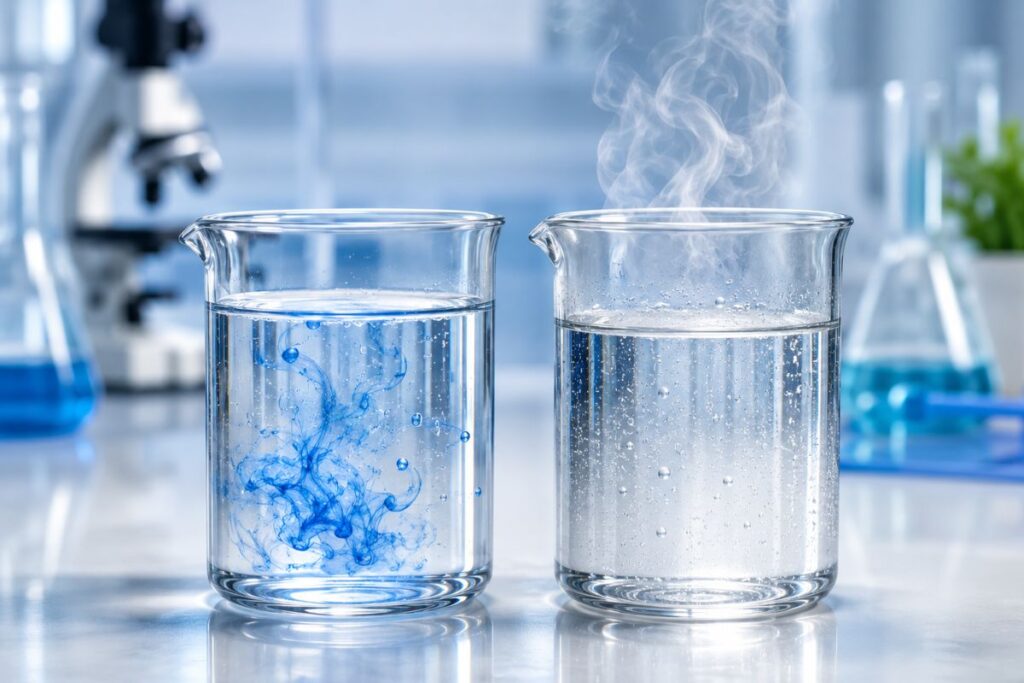
Quick Answer – Deionised water removes dissolved mineral ions through ion exchange, while distilled water is purified through boiling and condensation. Both are used in laboratories and industrial applications, but the best choice depends on the required purity and intended use.
Deionised water and distilled water look identical. Both are purified forms of water.
Yet, they are made using different processes. They are not always interchangeable. People swap them often, you know. That is a mistake. Deionised water has mineral ions removed. Distilled water comes from boiled steam. Your choice depends on your specific needs. Contaminants dictate what you should use. Water specs dictate everything here.
Key Points
- Deionised water: Removes dissolved mineral ions through ion exchange.
- Distilled water: Uses boiling and condensation to remove many impurities.
- Main difference: Both use different purification methods and remove different types of contaminants.
- Common uses: Laboratories, industrial equipment, and specialised applications.
- Which is better? It depends on the required water purity and intended use.
This guide breaks down both options. We look at production methods. We cover pros and cons. Let us help you choose the right.
Deionised Water vs Distilled Water
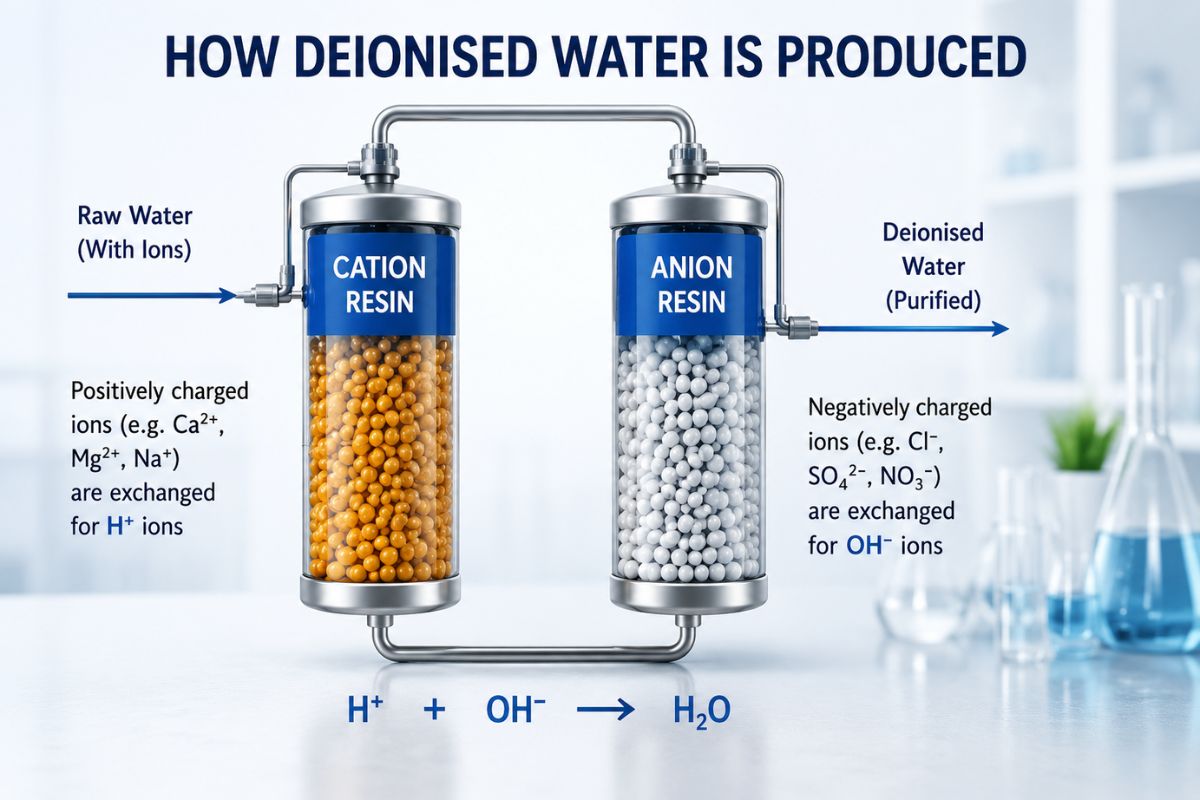
Deionised water (DI water) uses ion exchange. Resins capture charged mineral ions. Calcium and sodium get pulled out. Sulphate and chloride get removed too.
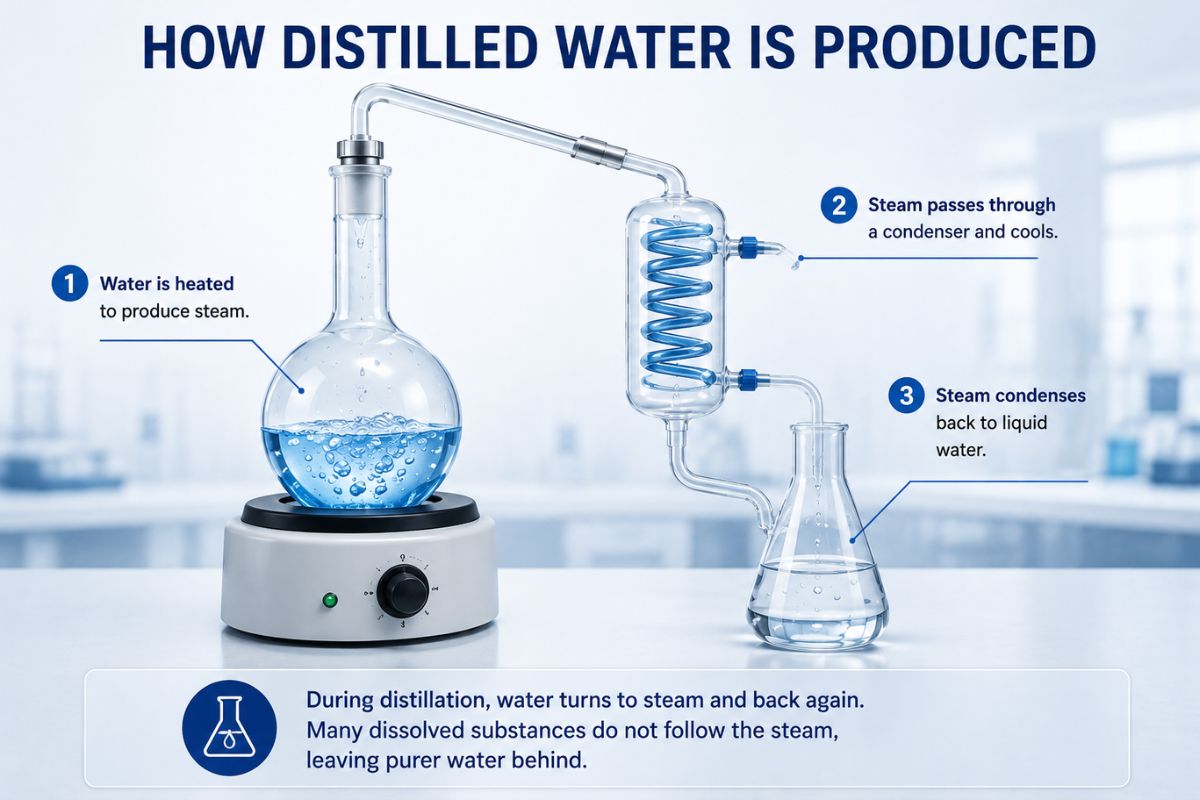
Distilled water relies on heat. Water boils into steam. Steam cools back into liquid. This process leaves heavy waste behind.
Neither option is always purer. That is a myth. Lab work demands exact specs. Look at actual water quality numbers.
ASTM D1193-24 sets these standard rules. It tracks conductivity and resistivity. It measures pH, silica, and sodium. It checks carbon and microbe levels.
What Is Deionised Water?
Deionised water has no charged ions.
Ion-exchange resins do the heavy lifting. Resins swap hydrogen for bad cations. They swap hydroxide for bad anions. Modern resins clear up to 99% of ions. It works well.
Common ions removed include:
- Calcium (Ca²⁺)
- Magnesium (Mg²⁺)
- Sodium (Na⁺)
- Potassium (K⁺)
- Chloride (Cl⁻)
- Sulphate (SO₄²⁻)
- Nitrate (NO₃⁻)
- Bicarbonate (HCO₃⁻)
Removing ions drops electrical conductivity.
Still, deionisation has real limits. Uncharged particles stay in the water. Bacteria and viruses remain behind. Organic chemicals can slip through. You might need extra filters.
This detail matters for lab work. Drug manufacturing requires extra caution.
What Is Distilled Water?
Distilled water comes from thermal boiling.
Water boils into rising steam. The steam cools into clean liquid. Distillation takes roughly 2.26 MJ per kilogram.
Most heavy junk stays behind. Minerals do not evaporate easily. Heavy metals stay in the boiler. Thermal boiling removes over 99.9% of biological contaminants.
Final water quality varies. Key factors include:
- Feed-water quality
- Distillation equipment
- Pretreatment
- Number of distillation stages
- Storage conditions
- Collection methods
- Additional filtration or treatment
High-end labs double-distil their water. They combine it with reverse osmosis.
Deionised vs Distilled Water: Key Differences
| Feature | Deionised Water | Distilled Water |
| Main purification process | Ion exchange | Evaporation and condensation |
| Primary target | Dissolved ions | Many dissolved contaminants |
| Conductivity | Low when processed | Low, based on system |
| Mineral ions | Clears up to 99% | Many get removed |
| Organic contaminants | May remain behind | Varies by boiling point |
| Microorganisms | Not cleared by resins | Heat kills over 99.9% |
| Typical applications | Labs, equipment cleaning | Labs, reagents, general use |
| Main consideration | Ionic purity | Thermal purification quality |
The purification process and final quality differ. Process names do not guarantee purity.
Is Deionised Water More Pure Than Distilled Water?
Not always.
People think distilled water is purer. That is not true. Purity depends on what you measure. It depends on your filtration gear.
Ion exchange removes dissolved salts. It leaves organic compounds alone. Distillation kills active bacteria. Yet, volatile chemicals can boil over.
Modern setups combine both methods. They add carbon filters too.
ASTM D1193-24 focuses on specs. Method names matter less than measurable numbers.
Do not ask which is purer. Ask what your process requires.
Conductivity and Resistivity: Why Do They Matter?
Pure water resistance is key. Dissolved ions carry electric current.
Fewer ions mean lower conductivity. Lower conductivity means higher resistivity. Theoretical maximum resistivity hits 18.2 MΩ·cm at 25°C. That is ultra-pure water.
Still, conductivity does not show everything. Other metrics matter too:
- Total organic carbon (TOC)
- Sodium
- Chloride
- Silica
- Bacteria
- Endotoxins
- Particulates
Always check the technical specification sheet. Read the certificate of analysis.
| ASTM Water Grade | Conductivity (µS/cm) | Resistivity (MΩ·cm) | Total Organic Carbon (ppb) |
|---|---|---|---|
| Type I | < 0.056 | 18.0 | < 50 |
| Type II | < 1.0 | 1.0 | < 50 |
| Type III | < 0.25 | 4.0 | < 200 |
| Type IV | < 5.0 | 0.2 | No limit |
What Is Deionised Water Used For?
DI water works where ions cause trouble. Minerals alter sensitive chemical reactions.
Common applications include:
1. Laboratory Work
Labs use DI water daily. It prevents unwanted mineral reactions. The required grade depends on test methods.
2. Equipment Cleaning
DI water stops scale buildup. Rinsing with it leaves zero spots. It keeps lab glassware clean.
3. Industrial Processes
Factories need mineral-free water. It stops boiler scale. It extends machine lifespan.
4. Electronics Manufacturing
Microchips demand ultra-clean water. Chip plants require conductivity below 0.056 µS/cm. A single stray ion ruins a chip. ASTM D5127 covers these strict electronic rules.
5. Chemical Preparation
Chemists use DI water for solutions. It stops unwanted side reactions. Ionic purity remains stable.
What Is Distilled Water Used For?
Distilled water fits thermal-cleaned needs. It works well in simple tools.
Potential uses include:
- Laboratory procedures
- Preparation of certain solutions
- Glassware rinsing
- Equipment applications
- Certain analytical processes
- General purified-water requirements
Quality changes across brands. Store bottles differ from lab grades. Oddly enough, plastic bottles leach chemicals. Check specs before sensitive work.
Can You Use Deionised Water Instead of Distilled Water?
Sometimes you can. Sometimes you cannot.
Need low mineral content? DI water works fine. It replaces distilled water easily.
Does your protocol demand distilled water? Then stick to it. Medical standards are strict.
Compare key test numbers first:
- Conductivity
- Resistivity
- TOC
- Microbial limits
- Endotoxin levels
- Silica
- Sodium
- Chloride
ASTM rules require proper water selection.
Is Deionised Water the Same as Demineralised Water?
People mix up these terms. They mean almost the same thing.
Both processes strip mineral content. Industry definitions can vary slightly.
Ignore marketing labels. Look at technical data sheets.
Check these metrics:
- Conductivity
- Resistivity
- Mineral-ion concentrations
- TOC
- Microbial specifications
- Other application-specific limits
Does Deionised Water Have a pH of 7?
Oddly enough, usually no.
Pure water should read pH 7. In reality, pure water absorbs airborne CO2 fast. Carbon dioxide forms weak carbonic acid. The pH drops down to 5.5 quickly.
Measuring pH in pure water is tricky. Few ions exist to trigger meters.
Never measure water purity using pH alone.
Which Is Better for Laboratory Use?
There is no single winner here.
Your specific lab protocol decides. Simple buffer prep needs basic water. Sensitive DNA tests need Type I water.
ASTM standards set clear purity levels. (ASTM International)
Always follow equipment manual guidelines. Do not guess specs.
Deionised Water vs Distilled Water for Cleaning
Both types clean without leaving spots. Tap water leaves white calcium stains.
DI water strips ionic film fast. It leaves surfaces squeaky clean.
Distilled water works for general cleaning. It prevents mineral spots.
Keep these details in mind:
- Surface sensitivity
- Residue requirements
- Ionic contamination
- Organic contamination
- Microbial requirements
- Required water grade
Storage containers pollute pure water. Airborne dust sinks in fast. ASTM D4453-17 gives clear storage rules.
Advantages and Limitations of Deionised Water
Advantages
- Removes dissolved ions fast
- Achieves low conductivity levels
- Ideal for industrial needs
- Runs on continuous systems
- Stops scale buildup in pipes
Limitations
- Leaves organic matter behind
- Resin beds wear out
- Bad maintenance ruins quality
- Air contact ruins purity
Advantages and Limitations of Distilled Water
Advantages
- Uses a proven thermal method
- Removes non-volatile solids
- Heat kills bacteria during boiling
- Reliable for basic lab tasks
Limitations
- Uses huge amounts of energy
- Equipment setup gets expensive
- Volatile organics can vaporise
- Storage introduces new contaminants
Which One Should You Choose?
Let us be real. Your choice depends on your target contaminants.
Choose deionised water when:
- You must remove dissolved mineral ions.
- You need low conductivity numbers.
- Your equipment fears scale buildup.
- Your lab manual demands DI water.
Choose distilled water when:
- Your SOP specifically orders distilled water.
- You want thermal boiling protection.
- The water meets required quality standards.
Choose a higher-purity, multi-stage purified water when:
- You run sensitive HPLC or PCR testing.
- Organics and microbes ruin your test.
- You conduct trace metal analysis.
- ASTM or pharmacopoeial standards apply.
Frequently Asked Questions
Is deionised water the same as distilled water?
No. Deionised water uses ion exchange. Distilled water relies on boiling and condensation.
Which is purer: deionised or distilled water?
Neither is universally purer. Purity depends on target contaminants and filtration quality.
Can distilled water be deionised?
Yes. Water can undergo multiple purification steps. Distilled water often undergoes ion exchange later.
Can I use DI water instead of distilled water?
Sometimes you can. Substitution works if both meet specs. Follow official protocols.
Is deionised water safe to drink?
No. Industrial DI water is not for drinking. Drinking water needs health controls.
Why does deionised water have low conductivity?
Dissolved ions conduct electricity. Removing ions drops conductivity and spikes resistivity.
What should I check when buying purified water?
Do not rely on product names alone. Check technical sheets for conductivity, TOC, and microbes.
Final Verdict: Deionised Water vs Distilled Water
Deionised water and distilled water are different. Neither is automatically better for every application.
DI water removes dissolved ions. Distilled water uses vaporisation to strip contaminants.
Routine applications accept either type. Sensitive industries demand exact water specifications.
The simple rule is clear:
Choose water based on target contaminants, not marketing labels.
Selecting correct water grades protects expensive equipment. It ensures reliable test results.
References
- ASTM International — ASTM D1193-24, Standard Specification for Reagent Water. Defines reagent-water characteristics including conductivity, resistivity, pH, silica, sodium, chloride, TOC, endotoxins and microbiological contamination. ASTM D1193-24
- ASTM International — ASTM D5127, Standard Guide for Ultra-Pure Water Used in the Electronics and Semiconductor Industries. Provides guidance on high-purity water requirements for electronics and semiconductor applications. ASTM D5127
- ASTM International — ASTM D4453-17(2025), Standard Practice for Handling of High Purity Water Samples. Covers handling practices designed to minimise contamination during collection, storage and transfer of high-purity water. ASTM D4453-17(2025)



Leave a Reply