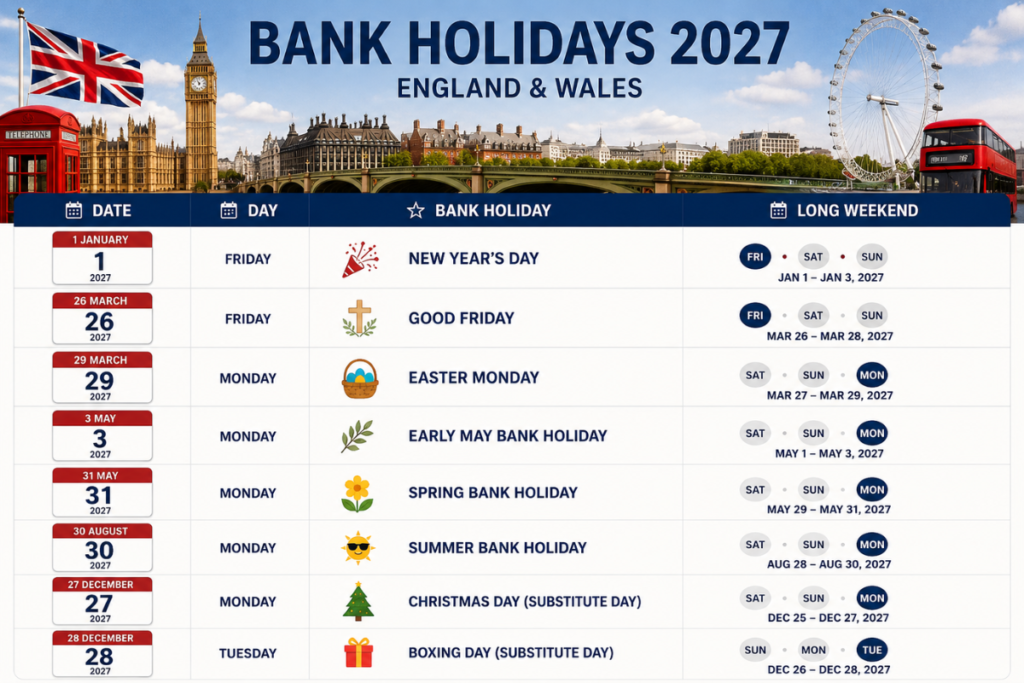
There are 8 bank holidays in England and Wales in 2027, 9 in Scotland and 10 in Northern Ireland. The first is New Year’s Day on Friday 1 January 2027 and the last is Boxing Day on Tuesday 28 December 2027. Both Christmas Day and Boxing Day fall at a weekend, so both move to substitute days. Dates verified against the GOV.UK bank holidays dataset on 11 August 2026.
Easter arrives early in 2027. Good Friday lands on 26 March, which is earlier than it has fallen in all but four years since 2000. That pulls the spring break forward and leaves England and Wales with a long, empty stretch of summer.
Here is every date, what changes by nation, and how to turn a small amount of annual leave into a large amount of time off.
Bank holidays 2027 at a glance
| Date | Day | Holiday | England & Wales | Scotland | N. Ireland |
|---|---|---|---|---|---|
| 1 January | Friday | New Year’s Day | ✅ | ✅ | ✅ |
| 4 January | Monday | 2nd January (substitute) | — | ✅ | — |
| 17 March | Wednesday | St Patrick’s Day | — | — | ✅ |
| 26 March | Friday | Good Friday | ✅ | ✅ | ✅ |
| 29 March | Monday | Easter Monday | ✅ | — | ✅ |
| 3 May | Monday | Early May | ✅ | ✅ | ✅ |
| 31 May | Monday | Spring | ✅ | ✅ | ✅ |
| 12 July | Monday | Battle of the Boyne | — | — | ✅ |
| 2 August | Monday | Summer (Scotland) | — | ✅ | — |
| 30 August | Monday | Summer | ✅ | — | ✅ |
| 30 November | Tuesday | St Andrew’s Day | — | ✅ | — |
| 27 December | Monday | Christmas Day (substitute) | ✅ | ✅ | ✅ |
| 28 December | Tuesday | Boxing Day (substitute) | ✅ | ✅ | ✅ |
| Total | 8 | 9 | 10 |
Source: GOV.UK bank holidays dataset. Last verified 11 August 2026.
England and Wales: 8 bank holidays
- Friday 1 January — New Year’s Day
- Friday 26 March — Good Friday
- Monday 29 March — Easter Monday
- Monday 3 May — Early May bank holiday
- Monday 31 May — Spring bank holiday
- Monday 30 August — Summer bank holiday
- Monday 27 December — Christmas Day (substitute day)
- Tuesday 28 December — Boxing Day (substitute day)
Scotland: 9 bank holidays
- Friday 1 January — New Year’s Day
- Monday 4 January — 2nd January (substitute day)
- Friday 26 March — Good Friday
- Monday 3 May — Early May bank holiday
- Monday 31 May — Spring bank holiday
- Monday 2 August — Summer bank holiday
- Tuesday 30 November — St Andrew’s Day
- Monday 27 December — Christmas Day (substitute day)
- Tuesday 28 December — Boxing Day (substitute day)
Two differences catch people out. Scotland does not observe Easter Monday, and its summer bank holiday falls on the first Monday in August rather than the last. In 2027 that puts Scotland four weeks ahead of the rest of the UK, on 2 August against 30 August.
Both differences are set in law. Schedule 1 of the Banking and Financial Dealings Act 1971 lists the first Monday in August for Scotland and the last Monday in August for England and Wales, and it does not include Easter Monday in the Scottish list at all.
Northern Ireland: 10 bank holidays
- Friday 1 January — New Year’s Day
- Wednesday 17 March — St Patrick’s Day
- Friday 26 March — Good Friday
- Monday 29 March — Easter Monday
- Monday 3 May — Early May bank holiday
- Monday 31 May — Spring bank holiday
- Monday 12 July — Battle of the Boyne (Orangemen’s Day)
- Monday 30 August — Summer bank holiday
- Monday 27 December — Christmas Day (substitute day)
- Tuesday 28 December — Boxing Day (substitute day)
Northern Ireland gets the most days of any UK nation, with St Patrick’s Day and the Battle of the Boyne on top of the eight observed in England and Wales. Both fall on a weekday in 2027, so neither moves.
Why Christmas moves in 2027
Christmas Day 2027 is a Saturday and Boxing Day is a Sunday. When a bank holiday lands at a weekend, the day off shifts to the next available weekday, which is why the dataset lists Monday 27 December and Tuesday 28 December as substitute days across all three nations.
The same rule pushes Scotland’s 2nd January holiday to Monday 4 January, because 2 January 2027 is a Saturday.
One consequence is worth knowing before you book anything. New Year’s Day 2028 is also a Saturday, so its substitute lands on Monday 3 January 2028. The Christmas 2027 window therefore runs unusually long, and it produces the single best leave deal of the year.
The gaps nobody plans for
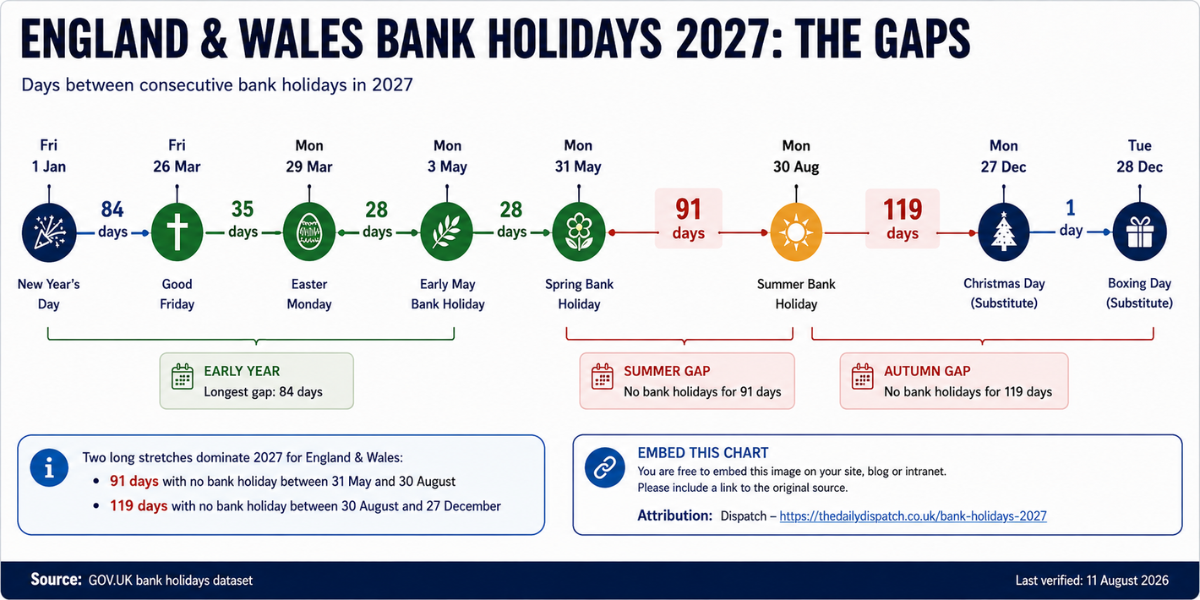
Bank holidays cluster at the ends of the year. Measured between consecutive dates in England and Wales, 2027 looks like this:
| From | To | Days between |
|---|---|---|
| 1 Jan | 26 Mar | 84 |
| 29 Mar | 3 May | 35 |
| 3 May | 31 May | 28 |
| 31 May | 30 Aug | 91 |
| 30 Aug | 27 Dec | 119 |
Two stretches dominate. There are 91 days with no bank holiday between the Spring holiday on 31 May and the Summer holiday on 30 August, and then 119 days from that Summer holiday until Christmas. Between the end of August and late December, England and Wales have no statutory day off at all.
Anyone managing a rota, a school calendar or their own energy levels should treat September to December as the part of 2027 that needs annual leave most and offers the least help.
How to turn 3 days of leave into 10 days off
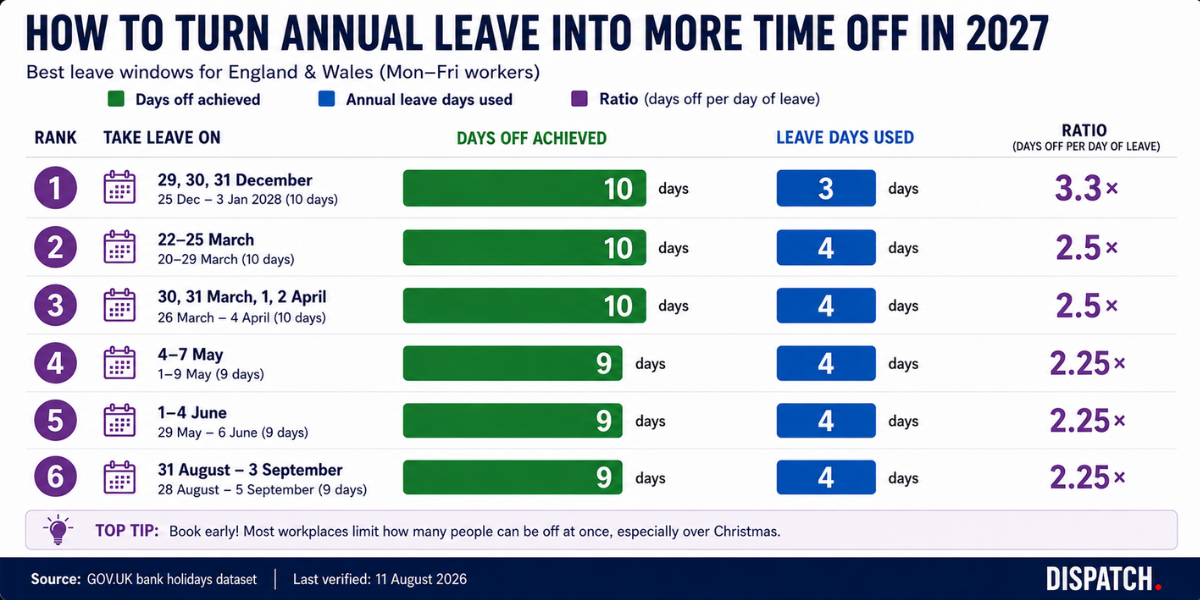
These figures assume a Monday-to-Friday working pattern in England or Wales, and count only the annual leave days you would need to book.
| Take leave on | Days off | Leave used | Ratio |
|---|---|---|---|
| 29, 30, 31 December | 25 Dec – 3 Jan (10 days) | 3 | 3.3× |
| 22–25 March | 20–29 March (10 days) | 4 | 2.5× |
| 30, 31 March, 1, 2 April | 26 March – 4 April (10 days) | 4 | 2.5× |
| 4–7 May | 1–9 May (9 days) | 4 | 2.25× |
| 1–4 June | 29 May – 6 June (9 days) | 4 | 2.25× |
| 31 August – 3 September | 28 August – 5 September (9 days) | 4 | 2.25× |
The Christmas window is the standout. Booking 29, 30 and 31 December gives you 25 December 2027 to 3 January 2028 off, ten consecutive days for three days of leave. It works because Christmas Day and Boxing Day both produce substitute holidays on the Monday and Tuesday, and because New Year’s Day 2028 falls on a Saturday and pushes its own substitute to Monday 3 January.
The Easter windows stack. Taking 22 to 25 March and 30 March to 2 April uses eight days of leave and produces sixteen consecutive days off, from 20 March to 4 April.
Two cautions. Most workplaces cap how many people can be off over Christmas, so book early. And if your employer counts bank holidays inside your annual entitlement, the arithmetic above changes, which brings us to the part most people get wrong.
Are you actually entitled to bank holidays off?
No, not automatically. This surprises a lot of people.
Almost all UK workers are entitled to 5.6 weeks of paid statutory annual leave, which works out at 28 days for someone working five days a week. Your employer is allowed to include bank holidays within that 28 days rather than granting them on top.
That means three arrangements are all lawful:
- Bank holidays off, paid, on top of your annual leave
- Bank holidays counted as part of your 5.6 weeks
- Working the bank holiday, at normal pay, with a day off in lieu or nothing extra
There is no statutory right to extra pay for working a bank holiday. Time and a half, double time and lieu days are contractual arrangements, not legal entitlements. Whether you get one depends on your contract, not on the law.
Check your contract or staff handbook. If it says your entitlement is “28 days including bank holidays”, the eight English and Welsh dates above are already inside your allowance.
Frequently Asked Questions
How many bank holidays are there in 2027?
England and Wales have 8, Scotland has 9, and Northern Ireland has 10. Across the UK, there are 13 distinct dates, because Scotland and Northern Ireland observe days the others do not.
When is Easter 2027?
Good Friday is 26 March 2027 and Easter Monday is 29 March 2027. This is an early Easter. Between 2000 and 2040, only 2005, 2008, 2016 and 2035 have or will have an earlier Good Friday.
Why is Boxing Day on 28 December in 2027?
Christmas Day falls on Saturday 25 December and Boxing Day on Sunday 26 December. Both shift to the next available weekdays, giving substitute holidays on Monday 27 and Tuesday 28 December.
Does Scotland get Easter Monday?
No. Good Friday is a bank holiday in Scotland, but Easter Monday is not, under Schedule 1 of the Banking and Financial Dealings Act 1971. Many Scottish employers grant it anyway as a matter of contract.
Why is Scotland’s August bank holiday earlier?
Scotland observes the first Monday in August, which is 2 August 2027. England, Wales and Northern Ireland observe the last Monday, which is 30 August 2027. The dates diverged in the late 1960s when the holiday moved for England and Wales but not for Scotland.
Can the 2027 dates still change?
The fixed and Easter-linked dates are set by statute. A one-off additional holiday can be created at any time by Royal Proclamation under section 1(3) of the Banking and Financial Dealings Act 1971, which is how the 2022 Platinum Jubilee and the 2023 Coronation holidays were made. We re-check this page against GOV.UK every quarter.
Do I get paid extra for working a bank holiday?
There is no legal right to extra pay. Enhanced rates and days in lieu come from your contract, not from statute.
How we checked these dates
Every date on this page comes from the GOV.UK bank holidays dataset, the government’s official published record for England and Wales, Scotland and Northern Ireland. Each day of the week was calculated independently and checked against that dataset rather than copied from it. The statutory rules on which nation observes which holiday come from Schedule 1 of the Banking and Financial Dealings Act 1971. The position on holiday entitlement comes from GOV.UK guidance on holiday entitlement rights.




Leave a Reply